Sunday, 3 July 2016

Days 52-60: Ljubljana, Pula, Zadar, Split, and Dubrovnik

I seem to have lost count of the days at some point, as I could swear that this trip was going to be 63 days in total, and my notes only go through day 56. (I have nothing else enlightening to say about this; I just could not help noting it.)

Of my train ride to Ljubljana I only faintly remember the mountains, hills, and serpentine rivers that we passed, though I believe that I noted the mountains’ being unusually verdant in the foreground and balder, grey with rock, only farther away. The most interesting experience of my train ride was a conversation that I had with a Frenchwoman. We got to talking about the differences in culture between northern and southern Europe. I decried the southerners’ laziness and commitment to lawlessness, while my interlocutor praised their independence and relaxed lifestyle and claimed that the only reason for which Germans follow rules is that they get fined if they do not. She complained that one could no longer smoke where one wanted in France and that, while northerners blindly obey laws, if an Italian does not like them—here she showed her middle finger. We agreed that France had just a touch of this southerly attitude, and I admitted that it was the only thing that I had disliked about the country.

When I arrived in Ljubljana, I immediately questioned why I had come. The train that I had been riding was headed for Zagreb; all that I would have had to do was to buy a ticket all of the way through, and I could have escaped Slovenia entirely, the caves be damned. When I looked for the tourist office, I found that it had been moved, replaced by a room that was only for selling tickets and was, bafflingly, open from 5:00 AM to 11:00 PM (trains barely run in Slovenia, and nobody takes them). A couple was waiting next to me for help in the ticket office. When it was their turn to go, they asked if they could buy an international ticket and were told to go back to the other ticket office, which, they explained, was closed; another employee had told them to come here. The man behind the desk was adamant. “Go to other office,” he said, and they turned around and left. I believe that I managed to get a city map at the train station—I am almost certain that I did—as I had an easy enough time finding my hostel and discovered that it was a dump, though it had a nice drying rack for one’s clothes (its being somewhere in the mid- to high-30s did not hurt). All of the men whom I passed, with their square, hardened faces and gnarled forearms, looked like out-of-work mechanics; they glowered, their arms all knobbly right angles, grizzled, as though the Soviet Union had never collapsed.

Ljubljana was not entirely dead, though—even in a place as hopeless as this, one finds signs of life. When I arrived, there was a beer and burger festival going on, and, by the time I went grocery shopping, I was starved half to death. I tried a burger, which was mediocre, then, still hungry (I had not been consuming many fats of late.), ate another, which was worse. I then shopped on a full stomach, which turned out to be a good idea, and relaxed for a bit before going for a run. Again, while I hate to admit it, Ljubljana did not strike me as completely derelict. It has a large public park full of reasonably well-marked walking trails; there was a small exposition of photos near the entrance to the park; I discovered, at the end of my run, that there was a free water fountain in the park; and I passed a couple of people singing and playing the guitar, and others listening, on my way back to the hostel. Even in the most desolate of places, people find a way to brighten their lives.

My bus ride to Divaca (near where I would visit the Skopjan Caves—you can look them up) was forgettable but probably seemed interesting in the moment—I really wish that I could have done day-to-day accounts of my travels so as to write more about my bus rides and train rides themselves, as they were sometimes some of the most interesting part of my travels. I saw a sign that said: “Stop./Shop.”, which struck me as bleakly materialistic (in signalling the emptiness of our lives outside of shopping), and, when I saw a man eating fruit-flavored yogurt, I was stabbed by the memory of eating cherry pie at a friend’s house as an adolescent. The caves themselves were spectacular and looked like one of the dwarf scenes from The Lord of the Rings—I noted this to the tour guide, who said that many other tourists had mentioned it to her, though she had not seen the movies herself; I told her that our view of the caves more or less encompassed them. While I enjoyed walking through the caves, taking the shuttle bus, &c., I did not have any life-changing realizations while doing so, and, since I have to write about Croatia and, eventually, get to my descriptions of the Dolomites, I will say merely that the caves were neat but were, at the end of the day, just caves.

I noted despairing of the cost of visiting the Skopjan Caves. I also noted passing a group of Asian tourists soon after arriving in Ljubljana and pitying them, as they were obviously trying to find vestiges of cultural in the area, and they may as well have been sucking blood from a turnip. While Ljubljana has some interesting and varied statuary along the riverbank, and while food and lodging there are cheap, there is essentially no reason to visit Slovenia beyond living in a country that is even worse. While Wikipedia has refuted my presumption, I would have assumed, while visiting the country, that LeBron James made more money than the whole of Slovenia, which does not appear, based on my somewhat superficial exploration of it, to have historically put much store in the arts, science, literature, or any other area of human endeavor.

The Croatian border police are mean. What I will always remember before anything else of my bus ride to Pula was the border police’s kicking a young girl off of the bus because she did not have a passport. This girl was part of a Dutch tour group for kids around 16 years old, and they were headed for a beach holiday. This particular girl had been to Croatia many times (some of their exchange was in English), spoke some of the language, and had never, in her whole life, needed more than her identification card to get through the border, but suddenly it was not enough, and, while I admit that rules are rules and they have to be upheld, I doubted that a sixteen-year-old Dutch girl from a youth camp was a likely terrorist, illegal immigrant, migrant worker, etc. She made a show of optimism, even making some sort of joke and laughing, as she stepped off of the bus (with one of the trip leaders, naturally), and, since she and the trip leaders had cell phone service, they were able to start making some sort of further arrangements, some of the girls were in tears, and, given that the girl was underaged and had a piece of identification, her expulsion seemed to me an act of unnecessary cruelty.

I remember nothing, then, of the landscapes on my way to Pula. The bus was hot, I am sure, as I remember closing my eyes at one point and thinking of the early days of fall in Vancouver, when the air is light and cool, the horizon still fuzzy with summer’s moisture when it goes white at twilight, and the year starts to gradually taper down to the warmth and comfort of home in winter’s cold and rains. When I arrived in Pula, I was reminded, by the profusion of cypress trees, of Rome; the city is full of Roman ruins, the crown of which, the city’s amphitheatre, is at least as impressive as the Roman Colosseum, partly for how well it was preserved, and partly for how starkly it emerges from the surrounding landscape (read: ugly, contemporary Croatian buildings). As a rule of thumb, everything in Croatia from at least 2,000 years ago is beautiful, and everything built since then is hideous. That is, everything built in the country’s recent history is ugly beyond description; many of the cities here have excellent monuments from the Venetian Empire, of which Pula was, for some time, a stronghold. It has fantastic beaches, some nearby hills, and, if my memory holds, a great many nearby islands, which are supposed to be quite beautiful.

I spent almost all of my second day in Pula lying in my air-conditioned room and trying to catch up on emails, my blog, etc., as well as not putting pressure on myself to take any day-trips. I skipped the islands for want of energy, inclination, and money to see them—I had started trying to scrimp on expenses at this point—and I decided against visiting Rovinj or Porec, nearby towns noted, respectively, for their Venetian old town and some old monastery or other; Rovinj looked like a poor man’s Dubrovnik or Zadar, and I was not interested in seeing another monastery or similar relic. I went running that evening and discovered an interesting facet of Pulan city planning: there are no trails for running near the beach—in fact, when one gets near the beach, one is relegated to sharing the road with cars—and one cannot run more than thirty or forty metres along the beach without bumping into a hotel and having one’s run interrupted. The Croatians proved not to be interested in contiguous pathways by the water, instead preferring somewhat exclusive sections of beach for different guesthouses. This may point to some sort of exclusionary culture, in which the better-off insulate themselves from the poor, but I expect that it is more closely tied to Croatia’s utter lack of infrastructure, which finds its way even to the smallest details of life here.

I spent my third day much as I spent the second, eschewing day-trips, relaxing, and exercising. I went for a bit of a walk through the city to get some groceries and fresh fruit, which was passable, and I carefully followed the directions to the nearest gym given to me by Google Maps and was transported to Russia in the early 1990s, right after the fall of the Soviet Union. For one thing, buildings here are not lined up on streets, as back at home, but scattered randomly on squares. Imagine erecting a bunch of buildings on the plaza outside of Koerner Library, giving them arbitrary addresses, and declaring that they were all on the same street—say, Westbrook Mall. This is the Croatian address system, which also holds in Russia. I call it Russia in the early 1990s because all of the buildings are broken down and covered in dust and graffiti, and an air of hopelessness, of a total lack of activity, swallows the place up. When I was looking for the gym, I passed a bunch of buildings (a bar, a small casino, a tobacconist, another bar, of which there are many here) that all looked almost identical—all Croatian buildings appear to either have no door or to have a door that is permanently locked, without any front steps leading up to it or anything to distinguish it from the walls around it (as glass, doormats, &c. have not yet been invented here)—and passed only one or two other people on the sidewalk. Finally, I gave in and asked a couple of men who were smoking if there was a gym nearby, and they had no idea, so I gave up and went running again.

I have, alas, skipped a great many impressions that I recorded in my notes. I visited an interesting museum about a passenger boat that was sunk outside of Pula at the outset of World War I, and I saw a few memorials (probably plaques) to World War II, again reminding me of its closeness to this area (Zadar was levelled during the war). Restaurant owners here are tremendously unpleasant: they stand outside of their restaurants and accost tourists, hawking their wares. There is nothing, really, to eat in Pula except for baked goods, of which I discovered that the black bread was quite good, and there appears to be no cultural life whatsoever in the town—it is a standard Croatian hick town with a few spectacular Roman ruins thrown in. (This is not entirely true. I saw a free art exhibition in the old town and chatted with the painter who had made it for a bit. He offered me cookies and juice and bade me sit down for a few minutes.) I have noted getting up late for no particular reason and feeling as though I were wasting the good weather and should have been doing something more active on my rest days. And I have noted my very first impression of Pula, when I had just gotten off of the bus and was heading toward the hostel, which was that it was a low-rent, overpriced Italy. Again people scowled; again they drove their motorcycles on sidewalks and parked their cars there; again they hogged the sidewalk and tried to push one off of it; and again there were no traffic laws or street signs to be found. I asked myself, when I had gotten off of that bus, why I had come at all.

I have three interesting cultural notes to make before proceeding to describe Zadar. The first is that the Croatian “language” has been a major frustration to me, as speaking it amounts to speaking hopelessly broken Russian. “Me want groceries. Where find? How much cost? Thank.” I noted (perhaps falsely—one imputes a lot of one’s prejudices to people rather than observing them) that people here have a much different way of sitting and smoking than people in Italy. When people here sit down for a cigarette, they take their time with it, smoking slowly and talking slowly. While Italians smoke compulsively as though it were a race and let forth torrents of unintelligible speech, Croatians smoke as though contemplating something (that is, when they are together), passing an occasional word back and forth and hardly gesturing at all (as I said, one has prejudices). My final cultural note is of one of the stranger and more striking interactions that I have had on this trip. When I got to the hostel in Pula and the owner showed me my bed, I started ruffling up the sheets, a common practice in hostels, to show that it was mine (as a free bed has neatly made sheets). The owner asked if there was a problem, and I answered in the negative, explaining, in brief, what I was doing. The owner took this as a sign that there was a problem, and we proceeded to have such a bitter argument that she suggested, after several minutes, that I find another hostel. When we had both finished frothing at the mouths and I had been successfully checked in, the owner again asked what was wrong with the bed, and I was finally able, the second time around, to explain that I had not doubted its cleanliness but was merely marking it as mine. I was fascinated, as this all happened, by the owner’s insistence on finding out what the problem was despite my having told her that there was none—I was reminded of a study that Bill told me about in which separate groups of people from different countries were, along with experimenters passed off as fellow test subjects, shown sets of images and asked to relate what they had seen. The experimenters passed off as test subjects (it is late at night, and I cannot remember what such people are called) would consistently give wrong answers to try to convince the test subjects to change their points of view—that is, whatever the test subjects said, the experimenters would contradict them. The idea (not spurious, in my opinion) was to see which country’s people would be the most inclined to stand their ground, and which country’s people were most inclined to agree with the false information that they were being fed. It was determined that Finns were the most likely to stick to their guns no matter what the experiments said and that Italians were the most likely to go against their better judgement in order to agree with the experimenters.

While I admit that one should not overextend generalizations from a nation’s people as a whole to every one of its individuals, it is undeniable that the peoples of different countries have different ways of interacting, communicating, behaving, &c., and it would be a failure not to try to understand them. (Norwegians, for example, are known for being reserved. Not every Norwegian is reserved, and not every Norwegian is reserved in the same situations, but the average Norwegian is likely to be more reserved than, say, the average American.) I wondered, after my spat with the hostel owner, if Croatians as a whole (I am not extending one interaction to cover all Croatians in all situations—I merely wondered.) were more likely, like the Finns in the experiment noted above, to stick to their guns when presented with a statement that contracted what their own eyes told them (I was rearranging the sheets—clearly, something was wrong, whether I admitted it or not.) than more reserved peoples, who might inwardly think that something was wrong but not object, hiding their wonder (or indignation) at what the crazy foreigner was doing and at his withholding what the matter was.

The trip to Zadar must have been quite beautiful, as my notes suggest that it reminded me of Gibsons. It started, naturally, with frustration, as I had to pay the bus company for luggage storage—people in Croatia are always looking to scam you. The bus was comfortable, though, and its air conditioning reminded me of the trip that I took to Cesky Krumlov a couple of years ago, when I felt as though I were going on a real journey, as they pampered us a little (making the bus ride feel almost like a flight). The bus driver drove on the right and wrong sides of the road depending on whether or not there were cars coming the other way, and I was nervous, as the road had no shoulder, that we would roll into a ravine, but we soon found ourselves on the coast, and I accepted that I had no control over the situation. The hills in Croatia are much different from those in, say, Salzburg, as they have only scraggly patches of vegetation and, unlike those in northern California, no grass. Instead, they are bald, grey like the mountains in the distance in Salzburg, with dry, shrunken shrubs like little tufts of dessicated hair. The coastline itself is, like that of B.C., marked by wooded peninsulas jutting left and right into the water, and there are pale blue mountains in the distance, like when one looks out at Vancouver Island. The day was clear on my bus ride to Zadar, the water endlessly blue, and a thin, white mist licked at the foot of the mountains. The hills sloped gradually down to the water, in which one saw a steamer here and there but hardly another boat—all was still. I was reminded of summers in Vancouver, of the view of Lions Bay from Mount Brunswick, of crossing the Burrard Street Bridge in the scorching heat of the early evening and biking along the beach. I was startled when the bus pulled into a beach resort, as I had not realized that we had been going gradually downhill. We started the upward climb and were soon high up in the hills again.

My arrival in Zadar was, of course, unpleasant—as soon as I stepped on the bus, I was surrounded by touts offering taxi rides and accommodations. (I recognize that touts are traditionally people offering fake help near major tourist sites, but these people are doing more or less the same thing, to my mind.) I thought of the importance, again, of basic honesty (my luggage had not been stolen from the hold) and I saw a sign that said, “Natural fruit. Best taste.”, which reminded me of all of the advertisements for “natural water” that I had seen; there were ocean liners, fast food joints, and exchange offices everywhere. Zadar brought San Diego to mind with its down-and-out-houses, cicadas, and palms. The map that I had printed from Google was wrong, but, as I soon hit the water, I was able to orient myself, and I started clambering toward my hostel. I wondered if I could ever return to southern Europe given how much it sucked.

Zadar struck me, as a whole, as much more cultured than Pula—it had museums and an art gallery or two in the centre of town. It had fantasatic, if not spectacular, Roman ruins and a beautiful waterfront, and it was close to a great many national parks and islands (this was to become a theme in Croatia). I tried and failed to find a gym again but came across a couple of chin-up bars, and I took a very expensive trip to the country’s most famous national park, Plitvice Lakes, for which I was glad that I had shelled out the money. (I was, at this point, scrimping on everything and forewent trips to museums that would have only cost a Canadian dollar or two.) I also began, since restaurants in Croatia were overpriced, I was uninterested in Croatian cuisine, and I wanted to save money, to simplify my diet. While it would not have made nutritional sense to do this for more than a week or two, I was interested, as in a game, in trying to eat healthily for as little money as possible: my diet featured milk, cereal, fresh fruit, canned peas, mozarella cheese, and enormous amounts of black bread (it was, in fact, fairly healthy, lacking only in variety and, perhaps, a bit low on protein). Mozarella keeps well enough that I could take it on day-trips, fruit was everywhere available, and black bread is sustaining and surely healthier than white bread. I decided to forego pastries in Croatia, which feature doughnuts, strudel, and layered cakes with custard heavily (it was hard to pass up on them), and I did not, in the hostels in which I stayed, have the cooking capacities for eggs or pasta, nor did I want to spend much time cooking at this point.

My bus ride to Split must have taken me along more spectacular coastline, I would assume, but I do not seem to have any notes about it. I remember arriving at the bus station, again being accosted by touts, and passing store after store, as though the station were more of a commercial hub than a medium for public transport. Of the city itself I have few notes. Split has a large public market and is the former site of Dioclysian’s Palace, an extraordinarily large residence that was mostly torn down as the city developed in the Middle Ages, but which has left us some spectacular ruins. It has a gorgeous waterfront (marginally developed, unlike the coastlines of Zadar and Pula), more picturesque islands, and, most interestingly, some nearby hills, heavily wooded and good for walking. I went for a run through the hills and discovered that they were full of churches that had been pilgrimage sites since, in some cases, the 13th century. I passed one church with a tap for holy spring water, from which I drank, and arrived at another that was hewn directly into the rock of the hillside. It would have been a good time to have my camera. The horizon was just starting to turn golden. I was several hundred meters above the water, as far from civilization as Bowen Island. There was a beach down below with buoys like little beads in the water; I could make out the shouts of children and the buzz of other voices. In the distance, the water met the sky, but closer, wooded hills grew out of the water. The sea was white on blue, what I have always thought of as sapphire white, when the evening light coats its deep blue in sheets of white that slide gently over the water’s waves.

I was very hungry, so I did not enjoy the view for very long, but I tried to imprint it in my memory, knowing full well that it would be gone within weeks. I ran back past the dapper and modest cypresses, their foliage as straight as though they stood in evening coats with their arms at their sides, past the same church with the holy spring, where I drank again. I passed other runners and dogwalkers; I passed tourists walking up to the viewpoint. When I got back into the city, the air changed seemingly instantaneously, as though I had passed through a barrier from the fresh hill air to the smell of cigarettes and exhaust that so characterizes Croatian cities.

I have to stop my narration for a few quick notes. Firstly, I forgot to mention that Pula smelt of urine and rotting compost, which contributed to my questioning why I had come at all when I arrived there. I forgot to note having been in a bit of a rush to get to the bus station in Zadar when I was leaving for Split and wishing that I had taken some photos of the street along which I walked. There is something oppressively hopeless about Croatian towns. Their sidewalks, when they exist at all, start and stop at random, leaving one to walk on the road. Cars park willy-nilly on the streets and sidewalk, and the Croatians have an unusual lust for grey, featureless apartment blocks. When their apartments are colored, their siding is crumbling, and they have small, almost nonexistent windows. Their balconies stick out like armies of underbites, and even the clothing drying on the lines outside seems somehow hopeless and dead. Croatian cities are not devoid of vegetation, but something in the hot, still air makes it feel as though everything were being baked and rendered motionless. Everything is cracked, crumbing, or falling apart, and one feels that it will never change.

My other note is of a funny exchange that I had with some Croatian travellers who were waiting to cross the street. Two women, huffing and puffing, were standing with a child and some heavy bags and saying, in their pseudo-language, “I not take any more.” I offered to help them, and, when I bent down to grab one of their bags, one of the women grabbed it as well, as though she were taking it away from me, though I discovered that she was trying to help by grabbing one of the two handles. While I meant to help them cross the street, I realized that it would do them no good, as they were on their way to the bus station, and they assumed, in any case, that I meant to help them go there, so off we went, pouring sweat, past the luggage storage kiosks, bars, and sandal shops lining the road. We stopped a few times so that they ladies could catch their breath, one of them turning, when she realized that we had a ways to go, and saying, “We will drink vodka.” A few minutes later, we got to the ticket office, and the older woman, who had studied Russian in school but forgotten it all, went inside with the child, leaving me to wait with the younger woman and the bags.

Up to this point, I had only once had an extended interaction (that I can remember) with someone with whom I had no common language whatsoever; this had been with a friend’s stepfather, who was driving me to some bigger train station than Friedrichshafen’s and announced the names of towns that we passed, laughing in his ruddy, jovial way. I tried, at the bus stop in Zadar, to engage the young woman in conversation, but with no luck. “Where are you going?” I asked. “We’re from Serbia,” she said. “Yes, but where are you going? To Pula? To Zadar?” She did not understand. “You go to Pula?” she asked. “Split? Dubrovnik?” I shook my head, ’No,’ and we laughed at our predicament. “Do you speak German? French? Italian?” She answered, ‘No’ to every question; I had already asked if she spoke English or Russian. I had seen the older woman talking to someone at the ticket counter, but, over the course of my attempted conversation with the younger woman, the older one had disappeared somewhere, and several minutes had passed. “Where is the other woman?” I asked. “What other woman?” This answer surprised me, as I thought that my question had been clear. “Your mother. Mom. The other woman.” She looked blankly at me, and I repeated the words ‘mother’ and ‘mom,’ assuming that at least one of them would be common to Slavic languages, without success. Finally, I said ‘sister.’ “She is not my sister,” the woman said, and I exclaimed, “Yes! Yes. That one! Where is she?” The woman was about to answer when the older woman stepped out of some room or other and began talking to someone else at a ticket counter. Eventually, she and the child emerged, and she explained that they would be leaving for Osijek, an 11-hour journey, in just over an hour. “Would you like a beer? Coffee? Come sit down with us.” I explained that I was about to go running, mimicking the movement (this is why I did not have my phasebook with me). “Water? Ice cream? Something” she offered. I refused again and, with her help, once she understood what I was trying to say, wished her and her family a safe journey. When I got back to the bus station just over an hour later, having finished my run, I saw that the bus was full of people and everyone’s bags had already been loaded—for once, a bus was on time in Croatia.

I am now nearing the end of my tale. I am having a rough go of it today: the idea of flying from Dubrovnik to Paris and from Paris to Vancouver instead of flying into Paris and out of Dubrovnik (or some nearby place) was harebrained to begin with; I thought that I could save money by flying into and out of the same city (for the trip as a whole), but the cost of getting to Paris has been at least as much as the added cost of flying straight from Dubrovnik would have been, and I was slapped with a 30-Euro fine for having oversized luggage, since, while Czech Airlines allows checked luggage of up to 23 kilograms, I booked my ticket through some other agency (called “Smart Wings,” which I found on vayama.com), and they only allow checked bags of 15 kilograms. I suppose that the moral of this story is that paying a bit more up front can save you a ton of hassle, and even money, in the long run, and that a deal that seems too good to be true really is too good to be true.

My arrival in Prague—as long as I am writing about this—was actually fairly interesting. I came, as some of you know, because my flight from Dubrovnik was moved a day earlier, forcing me to spend the night in Prague, and, while I was initially upset at this change, it worked in my favor, as Dubrovnik was over-the-top expensive, and I needed a rest. My hostel in Prague (near the airport—thank you, Kathie) was easy to find, and, when I had paid for it, I found that I had changed more money than necessary (for fear of having too little), leaving me with a pull 250 koruna, or $13 Canadian, to spend on groceries. The day was pleasantly cool; I saw what looked like a chin-up bar but turned out to be part of a strangely shaped bench; and I was looking forward to a night with a room of my own. When I got to the grocery store, a mild euphoria came over me when I realized that all of the food around me could be mine. Carefully calculating costs, I bought enough food for three people with, as it turned out, 22 koruna (to be donated to charity) to spare, and, walking back, I felt a light breeze and thought of airing out my room and going for a walk the next day. I did not, in the end, take that walk, as leaving my luggage in the care of the hostel employees would have been impracticable; instead, I waited downstairs, despite the employees’ wanting me to leave, and met a Ukrainian dancer, who made $67 (in Canadian currency) back home in Kharkov and was travelling with another choreographer for work. She talked about people’s having to work multiple jobs just to get by due to massive inflation on account of the war and said that she would not be unhappy if Kharkov were swallowed up by Russia, as life is better there.

Alas, I should return to Dubrovnik, or to Croatia broadly. My trip to Dubrovnik took me, like my previous bus rides, along the coast, giving me an excellent view of the Adriatic Sea. Like much of Croatia’s coastline, the area was mountainous, and on some curves it looked as though the mountains were lining up, one after the other, and looking over one another’s shoulders as though waiting their turn at something. Ocean liners cut occasional swathes through the sea, but it was otherwise calm and broad and met the land far below, where the cliffs’ white rock dropped into it.

We crossed the Bosnian border twice, but nothing interesting happened, except that I found free places to urinate, since I did not want to have to pay to do so (and only had, besides money for my hostel and the airport transfer, eight kuna, or roughly a Euro, to my name). When I arrived in Dubrovnik, I decided to change a few more American dollars (as I was saving my Euros for my transfer in Paris) so as to go shopping and see the city walls. The walls themselves are one of the more spectacular architectural works that I have ever seen—Dubrovnik reminded me of Venice, in that it was an overpriced, exceedingly popular tourist destination that deserved ever bit of its popularity, for it was stunning. It was very hilly, which could partly explain its historical importance (as it would have been tough to attack); it was, to everyone’s surprise, near a bunch of gorgeous islands; and there were lots of interesting possible day-trips to somewhat nearby cities in Bosnia and Montenegro. As in any of the cities that I had visited, I could have happily spent several more days here if I had had the time, money, and tolerance of the country’s lack of infrastructure and industry.

I walked through the old town of Dubrovnik on my first evening there, passing multitudes of overpriced restaurants in addition to candy stores, currency exchange offices, and giftshops. Of my walk I have little to say except that I finally saw a couple of Dalmatian (or, more broadly, Croatian) churches, of which I had only seen one, and that by subterfuge (I slipped in with a group of Korean tourists—it is a long story.); and I found that the churches were, on the whole, smaller and more restrained than those of Rome (though one could say that of any churches, I suppose). There was a concert of some sort in front of the cathedral—I forgot to mention that a group of men had been belting out throaty, traditional Dalmatian songs in Split. I think that that is about it. I wondered how any of the poor Croatians ever made it home for the number of steps in the old town; the city was clearly developed before the widespread introduction of tobacco products to the area. I spent my second day, or, rather, morning, not being allowed to walk the city walls, as my student card (like all North American student cards, as far as I know) had no expiry date; in a foul mood, I walked up one of the city’s hills to get a panoramic view of the old town and got to see tiny people walking the walls. From there I took the bus, which was twenty minutes late, to the airport, which turned out to be almost as sleepy as that of Northwest Arkansas—it was much smaller and less busy than I expected. Check-in was very quick, and the lady working at the counter, having explained that my bag could only weigh 15 kilograms, let me check in anyway without a fee when she saw the look of surprise on my face.

I am now just twenty-odd minutes from boarding my flight to Paris, and I still have not yet written my account of the Dolomites. Every piece of writing on this trip has taken longer than expected, and I have always found a way to put off writing, for some reason. While I still intend to take a trip around the world after my year in Russia, I wonder if I could survive less developed places than Italy or Croatia given how much I despised them; I may have to change my itinerary, seriously adjust my expectations, or change my mode of travel, perhaps seeking a second person for certain legs of my journey. Whatever the case, I have found the notes that I made en route to Ljubljana, and I remembered a funny anecdote. My notes are, as expected, that I liked the train ride and the verdant mountains but that I wanted to hike them, not just look at them. I saw a castle with what looked like a bunch of wooden attics, a church at the top of a hill, and forests of larch and dark firs on the nearby, wooded mountains. I also noted, probably because of the heavy, honeyed light filtering through the train’s window, thinking of June days in school as a kid, when the year was winding down and the afternoon sunlight made one want to fall asleep or burst outdoors.

It must be obvious, from the account above, that I never found a gym in Croatia. On my last day in Salzburg, I decided to go to the gym, and, while I was unhappy to have to pay $10 to do so and unhappy that I considered this a somewhat fair price, I was glad that I had chosen to work out there rather than in Slovenia, as, while it would be cheaper in Ljubljana than in Austria, the gyms there could have been in God knows what condition (if they even exhisted), and going to one might result in one’s being mugged. The gym in Salzburg was plenty modern but very strange. When I said that I would like to pay for one visit, the woman working there asked if she could see some ID. I told her that I had nothing on me—I had come to work out—and she gave me a sheet of paper to write my name and address on. When I had given her my money, she asked if I wanted a towel. Since I never use towels at the gym, I said, “No, thank you; I’ll be fine,” and she said, “Actually, it’s a policy we have—you have to use a towel.” Having never used one before in a gym, I asked if I should lay it on the bench when I worked out on it. She did not understand. I asked if the towel was meant to be lain down on exercises in which one was lying on one’s back, and she said, “Actually, I don’t know; it’s just a rule.”

I am now going to put my laptop away and get my book out; I have the Dolomites to describe and one more anecdote to relate. I should probably be able to send my next email tomorrow morning. I am getting much more into writing about this trip again now that I have time enough to do it.

Ljubljana's claim to fame is that James Joyce once set foot in it.

Ljubljana's inimitable city centre.

A castle on a hill, a church, and a statue of a dragon.

This part of town is, to my disappointment, genuinely pretty.

Slovenians have discovered the free water fountain.

The burger festival. I hungrily partook in it.

The entrance to the Skopjan caves.

A pool with water coloured by limestone.

A view from a cliff above the caves.

Pula's amphitheatre up-close.

A Roman arch.

Another Roman arch.

Part of the wall of a medieval fort.

This is the amphitheatre as set within the city.

A precipitous side-alley.

A phenomenally maintained Ancient Roman church.

This is what contemporary Croatia looks like.

A Roman mosaic.

More Roman ruins.

Cool foliage.

Not for the faint of heart. Fruit at the market in Pula.

I love you, Croatia.

On the way to the seashore (which I could not reach).

The foundation of a Roman street, perhaps in Zadar.

Zadar.

Part of an old wall in Zadar.

This wall must have been old, or I would not have photographed it.

The sea.

Zadar's waterfront.

The cobblestones of Zadar's side-streets were oddly slippery.

Just another market.

A cool-looking church; surely in Zadar.

I hope that this is a different Roman column.

The foundation of some Roman buildings.

As above, on a larger scale.

This looks to have been a temple.

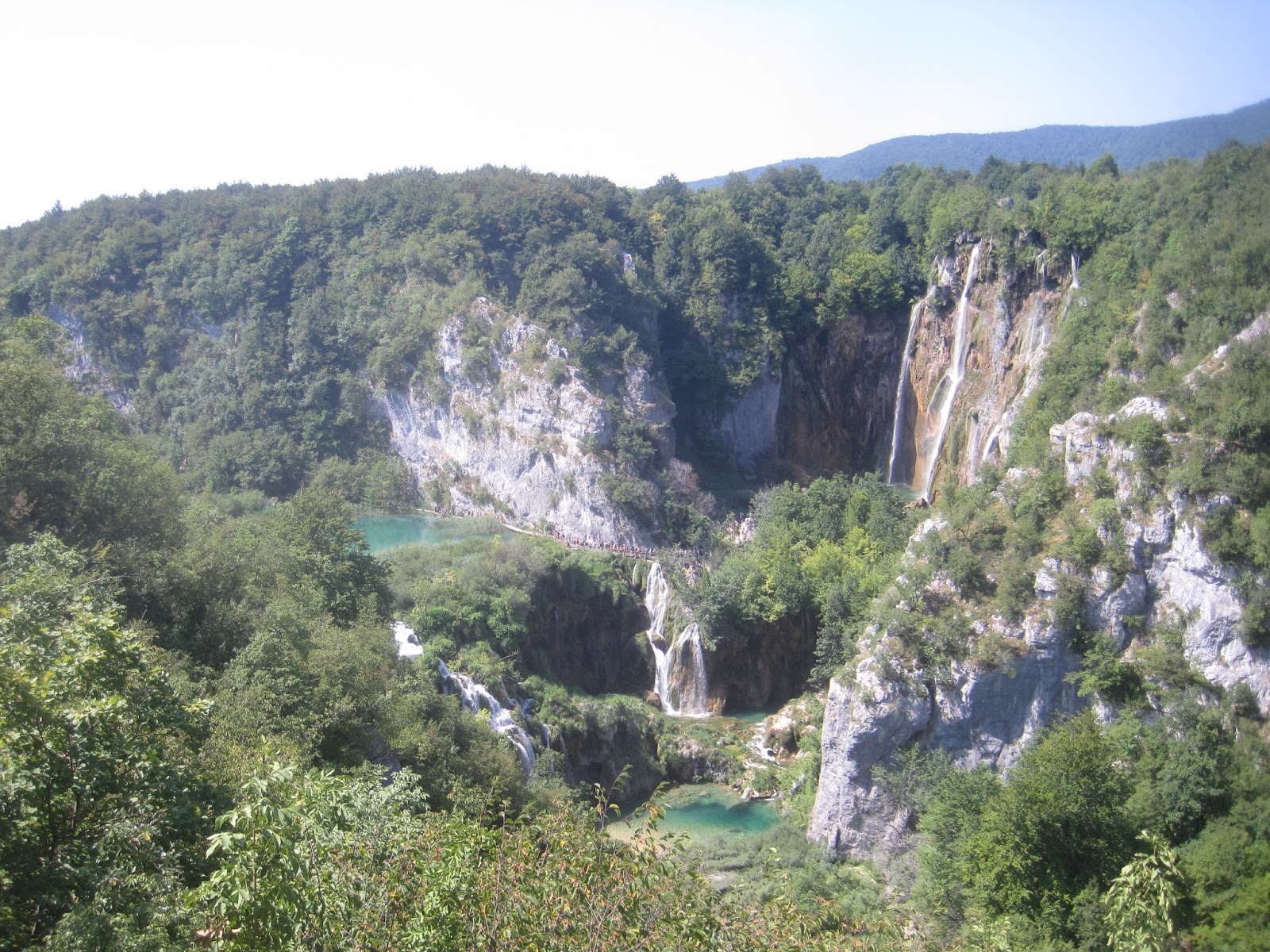
Plitvicka National Park (sp?). Worth every penny.

The awesome turquoise of the water.

As above.

Yet more turquoise water.

One of many little waterfalls.

The water from a little higher up.

It was damn near transparent.

On the ferry to the other shore (free, if I remember right).
The seashore in Split.

A market in the centre of town.

A standard apartment block.

Part of the wall of Dionysian's Palace.

Part of the wall showing wear.

An exceptionally majestic part of the wall.

A narrow street in Split.

A giant gateway.

More of the wall.

Another narrow alley.

Some sort of temple--perhaps from Roman times.

The circular hole in the roof of a temple.

The Adriatic Sea.

A greengrocer lost in thought at the market.

A famous observation tower in Dubrovnik.

The edge of Dubrovnik's defensive wall.

This other angle shows just how high it is.

The wall's sprawling length.

A cobblestoned street in the old town.

A steep street that would cause problems for smokers.

Another narrow street.

More of the wall.

Dubrovnik from above.

The shoreline.

A wooded island near it.

These appear to be figs.

My feet at the end of the trip.

Paris in the evening. Order and reason!

Days 49-51: Salzburg


I have no memory of getting on the train to go to Salzburg, but I have a great many notes about the trip there. (Correction: I have very few.) I seem to have noted the “cute houses,” whatever that means, and the churches that have bulb-like steeples (called, I believe, onion bulbs, or something like that). I do not particularly remember the landscapes, I am afraid, but I am pretty sure that they were visually pleasing (as were those near Salzburg, which I have also mostly forgotten). I noted the awful, expensive fruit in Salzburg; like any other German or Austrian town, it has a public market once a week (on Thursdays, I believe), and the market features all manner of food and crafts, including overpriced nectarines that could crack someone’s skull (perhaps meant to be used as hammers) and gooseberries like something that the cat dragged in. Food was overpriced in Salzburg, but I am getting ahead of myself, as, in this letter’s time, I have not yet even arrived there.

I started my trip in Salzburg, apparently, by seeing a girl sitting by the restraining bar next to the railway tracks and thinking of our shared humanity. While this seemed like an auspicious beginning, the first thing that I did in Salzburg was to be duped. To make a long story short, instead of checking into my hostel and then planning my day-trips to Salzkammergut and Konigssee, I went straight to the tourist office, which was in the train station, and booked a day-trip for 40 Euros. When I got to the hostel, I learned that I could get to Konigssee and back on public transit for only 9.75 Euros, which would also give me more freedom to explore it. I went back to the tourist office, complained, and got my money back, but not without putting out an employee, who claimed that she was making a major exception for me. I felt, afterward, like washing my hands of both my and the tourist agent’s fault: while I should have been smart enough not to visit the tourist office when I was tired from a long train ride and disinclined to explore my options in depth, the woman working there ought to have told me about all of my options, as she putatively works for the city, not the tour companies themselves. My backpack is in tatters and has worn a giant hole in the back of my shorts, which are stained in nectarine juice (from Munich, where the fruit was overpriced but at least passable) and god knows what else. I do not look like the kind of person who goes on 40-Euro tours.

I did not bother to explore much of Salzburg, having been there before, on my first day but went running along the river in the evening. One forgets, not having been there in a while, how much of a fairytale the city is. Its streets are well-ordered and are lined with clean, eighteenth-century buildings; it is full of baroque castles and little side streets; it has the remains of a fortress, with defensive walls and turrets; and its crowning feature is a white hilltop castle, complete, I am afraid, with the stains on one wall from its positioning under a primitive sort of outhouse for hundreds of years. The paths along the river are well-marked and separate bikers from walkers; the riverbank has plenty of green space, where people gather in the evenings to watch outdoor movies and walk tightropes between trees; and the castle catches the golden evening light in such a way that one does not even notice the stains on its wall. I suppose that running along the river showed Salzburg to me in a different light from walking through its city center, much as it has done with many other cities, as it enabled me to see it from a distance as an outside observer.

I decided, on my second day in Salzburg, to visit Konigssee rather than Salzkammergut, as the former has better mountains, while the latter is largely just a lake. I must have spent the morning doing something or other—perhaps relaxing in the hostel or walking through the new town—whatever the case, getting to Konigssee was trivial, though I left a little later than I should. I passed a lot of the same sorts of stone buildings, churches with onion-like cupolas or stick-thin, black spires, and neat little guesthouses with bunches of flowers on the windowsills. Many of the towns had whimsical statues near benches or near their town squares, such as of people talking, scarecrows, or smirking gremlins—Germanic statuary reflects a real sense of fun. Some of the countryside that we passed was more agricultural; I even saw a man threshing wheat—the poor sucker was working! Gas, I noted, cost $1.52/litre, two lower prices, and $1.32/litre just outside of Salzburg (from fancy gas to diesel), while, farther outside of town, the prices ranged from $1.39/litre for fancy gas and $1.15/litre for diesel, which surprised me, as I could not fathom its being cheaper in Austria than in any part of Italy, where people appear to have exponentially less money.

The highlight of my trip to Konigssee may have been the bus ride there, not because the hiking there was bad, but because the ride itself was so out of the ordinary for me. The first bus that I took deposited passengers at the bottom of the road leading up to Koniggsee (the “king’s sea,” a large mountain lake), where a great many people had already assembled when my bus stopped. By the time the bus up to the lake arrived, there were so many of us that we ended up standing literally shoulder-to-shoulder, breathing one another’s breath, each person’s chest pressed to the back of someone else. The fun part of the bus ride began when we started on the winding mountain road. None of us was initially prepared for the bends in the road, as a result of which the whole sweating, writhing, squirming mass of us pressed, like a wave, against the seats closest to us, and I felt as though I were in a rollercoaster (oddly, as rollercoasters have nothing to do with such close physical contact). This continued for a while, all of us holding our breath when we came up to curves and swaying like sea lettuce, until a few people got out, freeing up a bit of space for us all. At that point, an adolescent girl who had stepped out to allow others to exit started crying hysterically (or maybe she had been crying for some time), perhaps from claustrophibia, which sobered all of us. The rest of the ride was mostly quiet, and we were all quite releaved to step off of the bus and breathe again. (I was thinking, as I rode the bus, of India, where, if I end up travelling there, I will surely take many such buses.)

I did not hike much at Konigssee, as I did not have much time, energy, or water, and I had not bothered to wear hiking boots, as I did not realize that the hiking would be so good. While the Bavarian Alps are nothing like the Dolomites, French Alps, or Swiss Alps, they have some peaks over 2,000 metres, and the lake itself is at something like 600 metres, if I am not mistaken. Trails there are well-marked; there are plenty of other people around; and the lake is ringed by souvenir shops and cafes, just the type of development that I find so reassuring (to the certain disdain of more serious hikers, or those who prefer wilder conditions). I took a short walk through the woods that gave me a bit of a view of the lake—I did not want to risk missing the bus back to Salzburg, and I had a lot of writing to do that night, I expect. On the way to the bus stop, I stopped by some men looking through a stationary pair of binoculars (for which one had to pay), and they pointed out the Eagle’s Nest, Adolf Hitler’s favorite mountain residence, which sat at the top of one of the nearby peaks.

While Salzburg has fewer reminders of World War II than many German towns, one comes across occasional possible relics of the war, such as a section of barbed wire near a monastery in the nearby hills and a U.S. Post mailbox nearby. The hills of Salzburg make for good walking: they are full of placards about the flora, fauna, and geology of the region, and they are home to medieval fortifications and a residence near one of their tops. I saw little, in Salzburg, more interesting than the hills: I spent my second evening walking through them, my third day relaxing and selling my old computer, and my third evening eating a phenomenal meal at an alehouse. The Austrian ethos for cooking seems to be, “If in doubt, add more calories.” They make phenomenal bread dumplings, the best that I have ever had—they are very rich (in eggs, one presumes) and are cooked in soup, making them tender and rich in the taste of the broth and herbs. Austrians take pork very seriously, often making fatty cuts of meat (again, cooking them in soup), from which the fat itself is quite easy to separate, which have some of the most tender meat that I have had. Finally, they are fond of sauerkraut, which they often serve with bacon bits, ensuring that one at least get a little bit of greens with one’s meal. I reflected, as I ate my meal, that it would go perfectly with the apple juice-carbonated water mix of which Austrians are fond, but Austrians’ preferred drink is, of course, beer. (They also like to smoke cigarettes with their meals; the restaurant at which I ate had no non-smoking section.)

I noted that Salzburg, like Lindau, had a great many cafes and restaurants, as opposed to Genoa, which, while it had a lot of those, proportionally had many more stores selling food that one could cook oneself—the cities appear to cater to different populations. I saw another amusing tee-shirt, which read, “I never liked you anyway,” and remembered a bit of the church rhetoric of which I had been thinking of late, which is both that we are all ignoble sinners and that we should believe in the power of one person—i.e., a king or other ruler—to save us and make everything right. Of Ljubljana I will have to say but little, as I have, again, been putting off working on my travel blog and have thus fallen behind. I do not know what has made me so reluctant to write except that I am tired, have a lot of other work to attend to (which I am also putting off, of course), and feel, having fallen behind in the first place, that the blog has become a bit of a burden, though I hope not to feel that way if I take another long trip. I will be headed to Dubrovnik, where I hope to finish up most of the rest of my blog, tomorrow, after which I will be flying to Prague and, I hope, finally writing about my tour of the Dolomites.

Part of Salzburg's historic core from across the water.

A mountain home in the Bavarian Alps.

A secluded building in the hills near Salzburg.

This guy is a sort of Grim Reaper.
Much of Salzburg's old city from the hills.

Days 44-48: Lindau, Memmingen, Konstanz, Ravensburg, and Biberach an der Riß

I am again swimming in notes, so I will have to present my observations in piecemeal fashion.

I noted, as I left Italy, that I had only learned something like thirty words in the language, including several of the cardinal numbers, a few words of courtesy, some basic phrases, such as "Where bathrooms?", and a few words related to trains and buses. By contrast, I had learned roughly as many of words within five or six days of my first trip to Germany with a phrasebook, the reason for the difference being that I wanted to talk to Germans, while my Russian (specifically, the swear words) covered everything that I wanted to say, beyond covering my basic needs, in Italy.

The mountains between Milan and Zurich were, as I had expected, fabulous. We passed stone buildings and churches, wooden mountain huts (some on stilts in case of snow), churches with tall, narrow, pointed spires, and buildings with paintings on the side (almost like outer murals) that looked like guild designs. At the border, four unregistered passengers were thrown off of the train, while the women across from me, both Armenian, did not even have their passports checked (I did, perhaps because of my then-thick beard.). We passed a few castles, including one with a crenellted roof that reminded me of Ferrara’s castle, and we passed an emerald lake, where people were sailing and swimming. The train had left Milan late, naturally, but was, by the miracle of Swiss railways, on time in Zurich, enabling me to make my connection to Lindau without difficulty. I was delighted to be in a clean, efficiently run train station with clear signage, even floors, escalators, and only the slightest scent of cigarette smoke, though I also noted that my side-trip to Germany was going to be way more expensive than was justifiable and that I could have saved a lot of money by just staying in Italy for a little longer.

In Schaffenberg, where I had another connection, it seemed that absolutely everyone smoked, making up for the cleanliness of Zurich, which was just a front; I took to hating Switzerland and keenly awaiting my passage into Germany. I do not know exactly when I crossed the border or what, particularly, I saw on my way there—rather, I do remember; my notes have gotten scattered. I remember the apple trees, cornfields, and shaggy-haired conifers with drooping branches like a bloodhound’s jowls (perhaps firs? I have to learn my trees one day); I remember the neatness and order of the towns that we passed on the way to Lindau. I caught glimpses of Lake Konstanz here and there until we reached Lindau, which is a promontory reachable by a strip of land only a few dozen meters wide. Lake Konstanz burst into view, glittering in the late evening light against the pale blue mountains in the distance.

The next few days were marked largely by trips to towns like Lindau—small, provincial German towns with interesting histories. I decided, on my first day, to skip my day-trip to Saint Gallen, partly because it would be expensive and I was tired of day-trips, and partly because I wanted to see more of Lindau itself, which was, as it turned out, celebrating a city holiday (like Canada Day, B.C. Day, &c., only in honor of the city). As soon as I started walking into town (my hostel being just outside of it), I was flooded with the optimism attendant with reentry into the first world. Trains ran smoothly; well-kempt houses stood in tidy rows, each separated from its neighbor, along the street; there were sidewalks, on which nobody drove cars or mopeds; and there were playgrounds everwhere for children. I passed a small church and what looked like an old mansion, a fancier version of, say, the Aberthau Community Centre, offest from the street by a large lawn and a ring of trees, like a hedge. Since Lindau is a small town, one walks right across the train tracks, rather than over or under them, and, when a train approaches, little bells go off at the crossing, signalling the lowering of the restraining beam (Do these have a name? I mean one of those beams that blocks off parking lots, &c.). I approached the strip of land joining Lindau with the mainland and again had to wait for a train—quaint as the bells were, the waiting would grow tiresome in a hurry. This gave me time to look around. People kept little garden plots in an enclosure next to the train tracks, and I even saw patches of wild strawberries growing near them. The water was a rich aquamarine color, its green tint, I would later learn, the product of algae that came in at that time of year, and it was dotted with little white sailboats under a cloudless sky. Drivers here are sane; streets have clearly marked signs; there are separate paths for bikers and walkers; and people stick to the prescribed paths. As I waited for the train to pass, people told jokes to one another across the tracks. The people of Lindau (or those visiting) looked vastly more fit than anyone whom I had seen in Italy; they had, evidently, learned the value of exercise. (They also smiled, which never ceased to amaze me. I think that only two or three people in total smiled at me in Italy.)

I would love to describe Lindau in depth, but I would like to get through my notes on Salzburg and Ljubljana so as to more or less catch up on my letters (ignoring the one about the Dolomites). It was fantastically beautiful: it has old towers and churches, including one from the eleventh century; it has the timber-framed houses that I have come to love so well; and it has a great many elaborately decorated (perhaps boroque?) buildings, including the city hall, which has murals drawn on the outside about the city’s history. Lindau was historically rich due to being a centre of trade between Italy and the city-states north of it, and, because it had little manufacturing, it is much less industrial than the bigger cities near it, such as Friedrichshafen. It has grown little in the past few centuries, and, while it has a few apartment buildings (outside of the peninsula), none of them appaers to be more than three stories high. The tallest buildings in the city are the churches and the old lighthouse, which probably makes one feel the city’s history a little more keenly.

I probably went running on my first day in Lindau—either that or on my second. The trails along the water were well-marked and took me through more orderly German towns, past apple, pear, and plum orchards all neatly lined up and covered with netting (Lindau was the first place that I visited that seemed to enjoy the benefits of mordern agriculture.). Other people were out walking or walking their dogs; very few cars passed. I reflected, as I ran, that, if I wanted to see beautiful shoreline again, there was no reason to go as far as Italy. The evening light was just beginning to fail when I returned from my run. I marvelled at the tranquility of the place.

While I went a little nuts on pastries in Lindau (many of them were based on sponge cake), I was preparing myself for self-abnegation (I have, somewhat to my regret, not eaten a single pastry since I left Lake Konstanz.), and I discovered the joys of black bread and of dark bread with seeds, both of which have enough flavor that, while one prefers to eat them with meat, cheese, or a combination of the two, they are just fine on their own with a pint of milk. The fruit on Lake Konstanz was good but not as good as I had remembered from previous trips to Germany—it included such rarities as gooseberries and red currants, with which I fell in love for their tartness and my not having eaten them on the trip. The meat store that I visited in Lindau had two lines (one needs a ticket from a machine in order to be served), one for meat and the other for sausage, and the smoked meat here is fantastic and various, though I did not get a full sense of it, as the one time I bought four different types of smoked ham for comparison, I also got some god-awful cheese, which looked innocuous enough behind the glass but had a strong enough flavor to negate that of the meat. There are reminders, in the form of little plaques saying that such-and-such a person lived in thus-and-such a house until 1943 or 1944, of the Holocaust everywhere, though fewer of World War II itself (or, at least, those memorials are not nearly as grandiose or obvious as the ones in much of Italy). There are few defensive castles here but many large residencies (simpler palaces) with white walls and ruddy roofs. The wading birds, raptors, and songbirds here are all impressive. People are friendly. There is even the occasional Asian foods store, as in the rest of Germany, suggesting, to me, that it is economically much better off than Italy (as if one did not already know), where I saw none. (Why would one set up a store where no one would buy anything?)

I admit that a few of the trains around Lake Konstanz were late, never by very much, but enough that one might miss one’s connection; I had forgotten just how many connections I would have to take to get from one small town to the next, and I forgot that constant train travel could be exhausting. (This is a key note for my future travel plans.) Looking back, I realized that what got me started on this mad point-to-point travel in the first place was having a spare day in Frankfurt—horror of all horrors—a couple of years ago and feeling that I could have filled it with something worthwhile if I had planned it better, as well as my not liking Cesky Krumlov and feeling that I spent more time in the Czech Republic than was necessary. It was then, given my hunger to see as much of the world as possible, that I conceived of going from place to place to place without rest days so as not to waste any time.

Of my day-trips from Lindau I have, luckily, little to say. Memmingen is where I got the fantastic roast meat and lousy cheese; lots of the towns that I saw had old towers, parts of of their town walls, churches, timber-framed buildings, and other such things that I like. I have noted the decent fuit here and the pastries. I noted, again, that I was spending too much money, and I also noted that I had been trying, since I was in Bologna, to figure out which day-trips I could skip instead of looking for more stuff with which to fill my trip, which was a sure sign of travel fatigue (and of having tried to hard to see it all). I visited a museum in Lindau that showed me how wealthy residents of the city used to live (they had very elaborately decorated furnaces), which included a painting modeled after a Rembrandt, whose style is so distinctive that, when I saw the painting and had not yet seen the name attached to it (I do not know if it was a reproduction or just an imitation.), I thought, “This guy’s been to the Netherlands!” I met a lady there who worked at the museum and showed me around a bit, pointing out where she lived on my map of the area and enjoining that I not forget her, and I had a great many pleasant interactions in general, including in Lindau’s old lighthouse, from which I could see the whole surrounding area (for just under two Euros), and in the library, where the lady working apologized for the noise coming from outside (the city holiday featured lots of heavy metal bands) and said that the buliding was usually an escape from the outside world.

I told a joke, during my first day-trip, when the trian was late that such a thing was impossible in Germany, and the lady to whom I told it laughed and said that it was normal. Jokes told by foreigners in halting speech are always funnier, somehow—that is, standards for them are lower—than when people fluent in a language speak them, probably because one is somewhat of a child when one cannot speak the language, making one’s ejaculations all the more unexpected. The only note of any real philosophical purchase that I seem to have made is that I saw a bunch of logs being watered, which seemed strange to me, on the way to or from Memmingen. This reminded me of how key agricultural innovations are and how far we are from the land and the production of the food that we eat—I always joke that milk comes form the supermarket, as that is where one buys it. I suppose that the final point of note is that I almost surely past a “hospital” or two. Hospitals used to be either almshouses or guesthouses for pilgrims; the best that I have ever seen was surely in Canterbury, where I learned around priest holes, or little bunkers where Catholic priests were hidden so that they would not be found and killed for preaching the wrong faith, and was reminded that the idea of having large numbers of medical professionals in one place where patients can be treated is a relatively new one (conceived god knows when or by whom). My trip to Lindau was peaceful and unremarkable, filled with small joys like the view of Lake Lindau from the cathedral in Konstanz and the sense that I was seeing Europe as it was five hundred years ago.
Dorothy, we're not in Italy anymore.

The inimitable Lake Konstanz.

Lindau's famous lighthouse and entryway statue.

This appears to be Lindau's old town hall. These were ornate.

Germany cuisine is spectacular.

An orderly German street.

A killer German market. Note the order and cleanliness.

Lindau from the observation tower.

Regal buildings in Lindau.

I do not know what city this is from--perhaps Lindau.

See the above.


Memmingen's old town hall. Germans know their architecture.

Churches and old buildings. Germany is the best.

Memmingen's town hall from a different angle.

This appears to be part of Biberach an der Riß.

As above. Timber-framed houses look wonderful.

This is a slightly less impressive town hall.

This is probably still from Biberach an der Riß.

As above. An old building of some import.

This building has interesting turrets.

Look! Germans really know their houses.

This is probably from the same town. Scratch that--it might be Ravensburg.

This is definitely Biberach an der Riß; its town hall is recognisable.

This is, evidently, a church.

This might be Ravensburg. Note the condition of the old buildings.

This is from Konstanz.
Part of Konstanz from the church tower.

As above--Lake Konstanz.

Days 41-43: Milan, Genoa, Turin


I am, alas, in the worst hostel in which I have so ar stayed—Ljubljana sucks. I will try to write this letter to the sound of the techno music blaring outside of my window.

I expect that I caught my train from Bologna to Milan, cursing my travel agent for having vicariously hauled me out of bed at the crack of dawn—it was an intercity train, and missing it would have been costly. People on the train mostly seemed as sleepy as I was; some looked a little tense, as though they were heading to business meetings. Someone had recently reminded me of the high fashion that one expects to see in Milan, so I began to look for it. The only evidence of it that I found was its being popular for men to wear shoes with no socks (and long, often corduroy, pants). I got so tired of seeing their bare ankles, which I considered flagrantly unfashionable, that to see a man in socks became a godsend.

Milan itself has very little recommend it as a tourist destination. It reminded me a lot of Chicago with its “brutalist architecture”—its large, solid, unadorned concrete buildings, built in both cities following their being gutted (by fire and war, respectively). The cathedral itself is a remarkable architectural achievement, and, tired and uninspired to walk fire, I ended up spending most of my time outside of it, eating nectarines and looking at the passing tourists. Milan had recently had an expo, and it is a major tourist draw for Russians, many of whom come with barely a word of English or Italian. I helped some of them to find the ticket office to get inside the cathedral (which is, of course, one or two hundred metres from the cathedral itself), while I helped another to decipher exactly what her ticket was for. My meeting her was kind of funny: I saw a Chinese-looking woman taking a photo of something and said, in Russian (for I almost always speak Russian in foreign countries), “Watch out!”, as a crane—that is, the type used for construction (do not ask why it was in the cathedral; evidently, they were doing some sort of work on the walls)—was coming toward her. She said, “Thank you” in a funny accent—she must live near the border and have studied, the language, I thought. When she asked if I spoke Russian, I realized that she must be Kazakh, and we got to talking; as it turned out, she was one of Kazakhstan’s most famous pop stars, and she and a friend of hers, who taught Russian at a university in the south but spoke it poorly, had bought tickets without knowing what they were for. “They were asking me what kind of tickets we wanted,” she said, “and I didn’t understand, so I pointed at random.” I was able to interpret for her, asking a cathedral employee in English what the ticket was for, and I showed her how to get to the stairs to the cathedral roof. She, in turn, tried to teach me a few words in Kazakh, and she told me how to find her on a social media site. “Just look up ‘Manzhar from Turkestan,’ she said; everyone there knows me.” It was true. I looked her up and listened to some of her songs (in that most bizarre of languages) that very evening.
My train ride to Genoa was marked by a funny coincidence. When someone asked to switch seats with me so as to be witht he rest of his family (for these were separate little rooms of several seats each, not dual columns of seating, as in most trains), I ended up in the same room as a theatre teacher from the University of Arkansas and her husband, who wrote and directed the best play that I saw while I was there (I will not, for the sake of anonymity, say which one.). It turned out that they were great friends with two of my former teachers and knew many of the other teachers there, past and present, and they were intrigued by our being, as it turned out when we got to talking, in the same compartment as a student of classical literature and a linguist (and her boyfriend, who was, sadly, an ordinary person). We chatted about fairly ordinary things on the way to Genoa, and I lamented not being able to say anything profound about Higher Art, as I wanted to say something profound but had nothing in store. I took a picture with my teachers’ friends at the end of the train ride (they were staying on to go to La Spezia) and emailed my teachers, who got a kick out of our having met in such an aleatory fashion.

When I got to Genoa, I discovered that I had printed the wrong map to my hostel, and a Genoese woman, originally from Peru, helped me to find it. My notes from that first day are, to my good fortune, scarce. I noted the nearby hills, dense with verdure, and the city’s obvious poverty—it is much dirtier than, say, Bologna; many of the buildings are run-down; it is full of cramped, dark side alleys. My most remarkable experience on that first day was, if my memory holds, going out for dinner. I ate at a hole-in-the-wall restaurant that an employee of my hostel recommended to me and had some of the best food in recent memory, a pesto dish and, for dessert, panna cotta (sp?). The pesto was Trapanese, or tomato-based, which I had not expected, but it had an incredible combination of flavors, layer upon layer of them (I think that I have already mentioned the multifariousness of Italian pasta dishes.), while the panna cotta, flavored with saffron, or something equally unusual, was better than I knew that food could be. I resolved to return to the restaurant on my last night to try the basil-based pesto and another dessert.

Turin, the city to which I was doomed to travel by dint of already having booked a ticket, blew me away. I remember almost nothing of the train ride there except that we passed what looked like the ruins of an ancient Roman temple outside of Genoa’s city limits and that I was surprised, on arrival, to find myself in a clean train station with seating for people waiting for their trains. I stepped out, having looked up the way from the station to the Palatine Towers on Google maps, and promptly got lost. When I heard a man giving directions to a woman in Russian, I stepped into the store at which he worked and discovered that it was a Russian grocery store, where I got my lunch for the day and something to take home. The owner, who had moved thirteen years ago, said that Italy had been much nicer ten or so years ago, before the crisis, but was now going downhill, and he advocated sending African migrants back where they had come from when they arrived on their boats. Our conversation, like all conversations, came with a highlight: when I asked the man where the main thoroughfare through town was, he told me how to get there but said that it was not worth going, as there was nothing worth seeing there but a market where I might get pickpocketed. (The street, named after the twentieth of September (an important date for Italians, as all cities seem to have a street named after it), goes right through the heart of Turin’s historic center and takes one past palaces for which it has been named a UNESCO World Heritage site.)

Turin was by far the most European city that I visted in the whole of Italy. It had broad, neatly arranged causeways, clean streets, and an overarching, non-Italian atmosphere of law and order. It is regal (in contrast with Genoa, quite clearly a workingman’s city); it is easily walkable (again, uncharacteristically for Italy, where to walk is usually to risk death in a vehicular accident); and it has an efficient tram system that reminded me of Strasbourg. Much of the historic city center was gutted, as in the case of, apparently, almost all northern Italian cities, during World War II, but it has retained some impressive Roman ruins, and many of its old churches and other buildings of grandeur are intact. There was far more to see than I expected, but I noted that the city was relatively uniform (with its broad streets and manicured four-storey buildings), while Genoa strikes the traveller in its variety, its layering of different cultures upon one another. Turin was quiet, had spacious public squares, and was not a tiring city to visit, perhaps because it was so much more orderly and pleasant than any other that I had seen in Italy—one actually felt kind of good while walking through it. It has a long, winding river, some nearby hills, and breathable air; it seemed like the kind of place where one could spend several weeks, not so much as a tourist, though there were plenty of museums to visit, but just as someone living there like a normal person (it really did not feel like Italy). People there drive sanely, and one of them even jumped out of his car to see if I was all right when I tripped on something on the sidewalk and fell down on the way to the train station.

I must have gone shopping and gone for a run when I got back from Turin. (I forgot to mention that, on the train, I met a woman who chatted with me, in passable French, about travel and the Greek crisis; she had heard that, if Greek left the European Union, other countries would also start to leave, and the system would be shown to have failed. This was probably the first time anyone in Italy engaged me in conversation on a train.) I had wanted to do a little cooking for some time, having done zero on the trip, and decided to try to eat like an Italian, buying, in addition to the pasta that I had been carrying around for weeks, mozarella, kale, pesto, and cherry tomatoes. I noted the evening light in my notes; I went running, one evening, along the waterfront, struggling, at first, to find it, as the area near the harbor was mostly industrial and laced with highways; and I must have enjoyed the light. Italy’s ubiquitous water taps (for they are not exactly fountains) are a real boon. (I noted my fatigue. I must have still been tired at this point, as I am now.) When I cooked dinner, I met an Englishman who had studied Arabic and taken a trip through the Middle East soon before the revolutions of 2011; he kept saying, when I described people’s behavior in Italy (and particularly in the south), “This reminds me so much of Egypt.”

I decided, on my third day in Genoa (blissfully), to skip Cinque Terre. It was, I knew, a sin, but I had to skip something in order to catch up on sleep and on writing my blog (which did not happen), had already seen a similar coastline in the Amalfi Coast, and was not intent on taking another train when there was so much to do in Genoa itself. Genoa is surrounded by hills, which are dotted with forts used for defensive purposes when people from the north wanted to ake it over. It has dozens of palaces, in which rich people used to host emissaries; parts of the city’s town wall are still preserved; Christopher Columbus’ house is there; and the winding streets themselves, with their churches and statues of the Virgin Mary, are fascinating. Every other building in its old town is a deli, bakery, fruit and vegetable market, restaurant, ice cream shop, or butcher; while cities like Lindau and Salzburg are chock full of restaurants and cafes, Genoa seems to have a lot more of the raw materials for making food, probably because its residents are so much poorer than those in Lake Constance or Austria. (Someone whom I met today agreed that people in the south of Italy might seem so angry all of the time in part because of their poverty and resentment toward the wealthier north; the people in Croatia, she said, all seemed angry, probably for the same reason.) Parts of the old town are very quiet, as in Venice, when one steps off of a main thoroughway onto a forgotten side street, and lots of locals wander through it, perhaps to do their shopping. As a whole, it was endlessly fascinating and varied.

It is, however, still a part of Italy. When I walked up a bunch of side streets to a viewpoint, I found the gate at the very top barred, and when I decided to take a trip by funicular to the nearby hills, I found the finucular out of order. An Italian girl originally from Germany who also wanted to go to the hills took me to the bus stop, where, when the bus came, I was sent across the street to get my ticket at the tabaconnist. I had the foresight to ask if I could get a ticket from the stop in the hills and was told that, no, I would have to get it down below. I ran back to the tabacconist, got another ticket from the wordless, saurian woman behind the counter, and was taken, a short time later, most of the way to my destination, the bus driver telling the German-Italian girl and me that we had to walk the rest of the way up the hill to get to the final stop.

From there, it was as though I had left Italy temporarily (not quite—the trails were poorly marked): I saw a total of four people, three joggers and one cyclist, while in the hills. The day was brutally hot. The paths were overgrown, in places, with weeds. Still, I could see nothing around me but forested hills and, as I got a little higher, the deep blue lip of the Mediterranean Sea. I saw a little string of a highway down below. A few liners sat out at sea. I was alone with the flowers, bees, rocks, and forts.

I did not explore the whole of the park, as I had not left myself much time and wanted to be back in Genoa proper before dinnertime for fear of the transport system’s failing and my being stranded in the hills; I turned back from my walk just as I was starting to run out of water. I regret to admit that the bus system in Genoa is not actually that bad: bus schedules are everywhere posted; buses come more or less on time; and stops are announced fairly clearly. Bus tickets can even be used as transfers for up to ninety minutes, which fact enabled me to switch buses in town and get one that went almost to the front door of the hostel. (I needed this; I was tired.) I went back to the same tiny restaurant as before for dinner; the waiter recognized me. To avoid paying extra (due to a deal with the hostel, which gave its guests a different, special, cheaper menu), I eschewed proper pesto for a dish of scallops and spaghetti, just as heavenly as the tomato pesto dish had been; for dessert, I had the best creme brulee of my life. It was delivered to me on fire, so I dutifully blew it out, like a birthday cake. The waiter protested and set it on fire again with a lighter; he said that I had to wait until the sugar had browned and the alcohol had burned away—perhaps thirty minutes, he joked. (It did not occur to me that the fire itself died down when its fuel, the alcohol, ran out.) My dessert attracted a crowd—that is, people from the adjoining tables watched it burn. I entered into conversation with the girls sitting beside me, a pair from Appalachia (sp?), and we talked about travel and environmental politics. This restaurant turned out to be an excellent place to meet people, perhaps because of being so small—the first time I went, I had met a pair of girls from Lyon, who claimed that one could make anything with the right olive oil and that only the French made real bread. I remembered what Dima, the man whom I had befriended in Bologna, had had to say about restaurant interiors, which interested him, as all of cafes in Irkutsk, he had said, had shiny, new interiors with bright lighting, and he had assumed that all cafes were like that until his wife and he had started travelling. His theory of what made a cafe interior pleasant was roughly that it be made of something closer to the natural materials, like wood and stone, that we encounter in the non-human world. Indeed, the interior of this cafe had uncovered brickwork and, if I recall correctly, a wooden ceiling; it had music playing on the radio and small distances between tables, and the waiter seemed more like someone doing his job, an ordinary, friendly person, than someone waiting on people or simpering before them (as in, say, the hotel in Dobbiaco, which was much more upscale). The interior seemed unabashedly old, and the restaurant appeared, to anthropomorphize it, not to be trying to be anything more than it was.

After this dinner (and ambrosian dessert), I reflected that there was so much to do in Genoa and the coastline surrounding it that one could easily spend a week or two here, as in Florence or Bologna; I even noted the possibility of spending a week in each of those places in five or ten years, though I have, luckily, realized that I will be unlikely to have enough money to take such a trip in five or ten years and that if I have the money, I will probably be smart enough to spend it in a country that does not suck. The fruit in Genoa was phenomenal. For just a couple of Euros, one could buy a kilogram of nectarines so ripe that the fruit ran down one’s arms and dripped onto one’s shoes. My final note is one that I forgot from Bologna: the owner of the hostel in which I stayed explained that the city tax still levied on visitors is a holdover from several hundred years ago (when it probably made some sense, as the city offered wayfarers some measure of protection); she joked that five hundred years had passed and nothing had changed. This sums up my impressions of Italy. I was delighted to leave the country on the 10th of July and do not intend to cross its borders again, as interesting as it was; and, while I would like to see Spain, Portugal, Greece, and Turkey (despite knowing that they will almost assuredly suck in equal measure), I at least know what to expect now and will not hope for them to show the slightest signs of societal development.

Milan's cathedral is astounding.

A tiny bit of Milan's old city survived the bombing.

Genoa is full of urban palaces like this one.

I cannot get enough of these little garbage trucks.

A broad Genoese street.

Note the difference in architecture. Open spaces define Turin.

Endless streets also define it.

It was an important Roman outpost.

This market was entirely unremarkable.

Genoa has lots of narrow side-alleys.

This is what it looks like from the hills.

A series of hill forts guarded it in times of yore.