Sunday, 7 July 2013

Day 37 - The Hospital

 
I am being punished, at this point, for not taking adequate notes over the course of the day. At the start of the trip, I would take notes assiduously, writing little reminders to myself on scraps of paper about interesting things that I saw during the day and would want to relate later on in my emails. Now, I tend to assume that I will take in all sorts of new impressions by osmosis and magically come up with something to say when it comes to write my emails; I have grown lazy. As a result, I wonder if I will end up finding anything at all to say.

I started my day by going to the hospital. I was immediately confronted with one of the problems with having hospitals, courts of law, schools, and so on in very old buildings: while they look nice from the outside, their entrances can be very hard to find. I had to walk around the block to find a back entrance to the hospital, at which point I would have been flummoxed had a security guard not happened to be standing near the entrance to the nearest hospital wing: unlike in a North American hospital, the Czech hospital had no reception area and no clear signs detailing where one should go to get treatment. The security guard directed me to walk through a door into a vestibule that could easily have belonged to a museum or theater if only it had had a ticket booth. I stood gazing all around me until another couple entered, and I followed the couple upstairs into a room smelling appropriately of damp plaster, in which a bunch of bored-looking people were sitting around on chairs. The couple that had entered just before me asked the room at large who was last in line, and a nurse who was passing by told me, when I asked the couple how to gain admission to the hospital, that Czech people had to buy some sort of entry slip downstairs, while I could get treated without doing so. I waited for about an hour-and-a-half, no longer than in a Canadian hospital (I should think), to be treated, at which point the nurse on duty, who spoke good English, grew worried that I might have an inflamed appendix and sent me to a room that had a cognate of "ambulance" in its name.

What followed was a battery of tests showing no problems whatsoever with the health of my major organs and suggesting that I had the most painful, most drawn-out, least-acute case of food poisoning of my life. I was impressed, loath as I am to admit it, with the Czech health care system overall: almost every nurse or doctor with whom I interacted spoke serviceable Russian or English, the testing done on me seemed very thorough, I was in and out of the hospital in reasonable time, and the whole affair only cost a little under 150 Euros - not bad money, all considered, and money that I can certainly refund, because of my medical insurance, when I get home (I am going to email the people tonight to tell them in advance what happened.). What seemed strange to me about the experience was that people in the waiting room said hello and goodbye to one another, chatted amongst themselves, laughed, and seemed to be having an all right time. I suppose that, since none of them appeared to be on death's doorstep, they decided to make the most of the situation.

I spent the rest of the day, from 2:30 onwards, resting. While I had planned to visit a famous castle in Lednice, I just barely missed the train there, and the lack of infrastructure in the Czech Republic is so frustrating that I decided to give up on trying to go anywhere for the day. I had filled out a prescription from the doctor whom I saw and had bought a pair of over-the-counter medicines on his recommendation, and I decided to spend the afternoon reading and watching a movie. I felt so tired that I ended up lying in bed instead, almost asleep, after which I had a very simple dinner of yogurt, a plum, and a ham-and-cheese sandwich made from the groceries that I bought on Friday. I have decided to eschew fresh fruits and sour foods for the next few days, but I figured that one plum would not hurt, as plums are not so tart and provide one with much-needed fiber.

Enough of dietary details! I may finally get over this illness over the next few days with the help of the medicine that I picked up today. It is interesting to think that the contents of my stomach will be somewhat different once I have taken a few more probiotic pills than they were a few days ago. When I was a child, I thought of the body as having two possible states, healthy and sick. When one was sick, one could only have one illness at once, as that illness filled up a slot for sickness, so to speak; when one was healthy, one's body was in its perfect, unblemished state. It turns out that the chemistry of the human body is much messier than that: the contents of one's stomach are constantly changing based on what one eats, and there is no single perfect state for them to be in. One wonders, after a week of constant illness and pain, if one will ever be healthy again, and yet it is obvious that one will be, as plenty of other people have gotten over stomach illnesses. The germane point here is that, even if one is pain-free after a week of recovery, one's stomach is not exactly the same as it was before and never can be.

My main observations for the day are that the Czech Republic sucks and that Gustave Flaubert does not. The Czech Republic's inadequacies, from the traveler's point of view, include its not having useful information points, its having infrequent trains and unreliable buses, and the fact that its personnel in the transport business rarely speak any language besides Czech. My advice, I repeat, is that one not bother visiting this country, as there are far superior places (Holland, France, Germany, Austria - and that is only counting places that I have personally visited) with the exact same highlights as the Czech Republic (castles, churches, medieval cities, delicious food) and none of its downsides (widespread poverty and an exceptionally-bad infrastructure). Seeing Prague might change my opinion about the Czech Republic, but I hope that it does not, as I hate changing my opinions, plus the southern part of this country is so abysmal that one nice city in its center could not sway me. I hope to continue disliking the Czech Republic until I leave it.

My mentioning Gustave Flaubert is a result of my having finished the book that I had been reading before - Moscow and Musovites, by so-and-so Gilyarovsky (I cannot be bothered to look up his initials.). I brought along a Graham Greene novel, The Power and the Glory, most of which I read on the way here, and the Bacchae, by Euripides, but have nothing else with me, reflecting some interesting choices. In effect, I assumed that I would spend less time reading than I have ended up doing and brought along books that I figured that I ought to read - books that I might never have read if I had left them at home. I am not much into classical literature and so assumed that I would never get around to Euripides (but I assume that he is important); I disliked Flaubert's Madame Bovary and Three Tales, as I found them belletristic; I was wary of Graham Greene, as many of his films had been turned into movies, which suggested to me that they were not serious literature; and I did not know if Moscow and Muscovites would be an interesting enough read to justify my wrestling with its sometimes difficult language, so I might never have taken the plunge and started reading it if I had not brought it with me.

Moscow and Muscovites turned out to give a fascinating account of Russia's 19th-century history through the lens of Moscow, and my suspicions about Graham Greene were confirmed: he is a second-rate writer. While I have not yet started reading the Baccae, I have so far enjoyed Bouvard and Pecuchet. I never realized that Flaubert was such a skillful satirist or that his powers of observation were so great: he never misses a single detail, placing readers very firmly in the settings of his book (or, at least, of this book). It strikes me that writers can be divided into two or so types: those who generally like telling stories, an those who tell stories for a reason. By "writing stories for a reason" I mean having an overarching goal in one's writing, that of communicating a worldview or essential set of ideas or describing some vital human experience in one's work. There are advantages to being either type of write: writers who take joy simply in telling stories are more likely to be imaginative, to just make stuff up, than writers who write for a reason, who are more likely to draw from personal experience and may have difficulty fabricating. It is my theory, however, that writers who write for a reason are far more interesting than those who write strictly for the sake of narrative. I hope to convince you of this in a brief didactic proof before going to bed.

Since I am hungry and should have started writing this email earlier - it is already 11:30 PM - I will cut straight to the point. Consider the case of Primo Levi, the 20th-century Italian writer. He had trained to be a chemist and worked as one for several years before he started writing. The only reason for his having started to write was to make sense of his experiences in a Nazi concentration camp - he had no other way to possibly understand them. As a result, he wrote some of the best works of 20th-century literature (that I know of). Dostoyevsky wrote with clearly-didactic aims; Grossman, Solzhenitsyn, Aitmatov, and Pasternak wrote both from personal experience and to document an epoch; Tolstoy, whom I dislike, worked from personal experience; Camus wrote fiction that personified his life philosophy; Boleslaw Prus wrote to document the lives of his people; Aldous Huxley wrote largely from personal experience; George Orwell had didactic aims; and so on. While I am sure that there are plenty of more imaginative writers who have managed to say things of philosophical importance, I consider it much easier for such writers to fall into the trap of telling stories but having nothing, at root, to say. Those stories are like cotton candy to the meatier, more motivated works of writers who do not tell stories strictly for their own sake. The example of such a writer that most readily jumps to mind is that of Evelyn Waugh, whose entire life philosophy, based on the work of his that I have read, appears to have been, "I am a jackass." I leave you with that thought, as I have to get to bed and should have tried to do so early, for once, but I could not quite manage it despite not having done much of anything today. Tomorrow I am off to see some famous caves near Blansko, and the day after tomorrow I will depart for Prague, the capital of this miserable country. Goodbye.
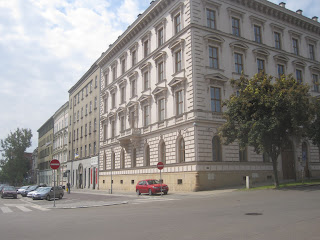

How does one enter a hospital that has no entrance?

Saturday, 6 July 2013

Day 36 - Olomouc

I have discovered why it is so cheap to travel through the Czech Republic: it sucks. This country has the worst infrastructure of any country that I have visited on this trip. I am now quite tired and have to get to bed soon, so I will have to keep this brief, but I recommend that none of you ever bother visiting the Czech Republic. While it has some interesting historical sites, it is about as close in development to Germany as Hungary is to Austria: it is shocking that they share a border, let alone that they are in the same continent. While I started to worry, on the train ride back here, that I would have to try to shorten my stay in Prague in order to escape the Czech Republic as quickly as possible, it now seems to me that there is enough to see near Prague to make staying there for six days worth my while, especially as I can always admit to having planned things poorly and spend a day developing my course syllabi and watching movies if six days in Prague really turns out to be too much. I would like to claim that this will be my last-ever trip to Eastern Europe, but I still plan to spend a few days in Serbia and Bulgaria, which strike me as too historically rich to miss, and about a week hiking in Slovakia, which will be with a tour group. Beyond that, I hope never again to touch down on Eastern European soil, as it is generally an unpleasant part of the world in which to find oneself.

My day was marked principally by frustration. While I had a fine breakfast, I left the hostel a bit later than I should have and, accompanied by a friend of one of the hostel employees, set off to try to find Brno's ossuary and to visit its hospital. Walking with another person reminded me how much I like to be alone when travelling: I was suddenly deprived of the freedom to stop when I wanted, take pictures when I wanted, and examine things that interested me or change my walking route. This is not to say that the man with me did not help me, as his presence was very useful, or that I did not like his company, as he was a perfectly-fine person; rather, it reinforced the benefits of travelling alone. We found out, when we finally made it there, that the hospital was closed to the day due to a public holiday. We were told to go to a hospital near my hostel, at which point I decided to see Olomouc before trying to inquire into my health any further. I had gotten a new bunch of pills at the pharmacy outside of the hospital and figured that I may as well give them a try before seeking out a doctor.

I ended up missing the bus to Olomouc and having to wait for two hours until the next one. I visited a fantastic, and very cheap, ice cream parlor near my hostel and saw Brno's ossuary, which was underwhelming, as it was much smaller than I expected it to be. The ossuary, it turns out, was made for purely practical reasons: inadequately-buried bodies, and the corpses of people who had died of infectious disease, could not be left in ordinary cemeteries for fear of spreading disease, plus the cemeteries had run out of space for new bodies. The underground crypts of bones were not made by someone crazy about death or someone trying to make a high-order statement about human existence.

My trip to Olomouc was enjoyable in itself; while I slept through most of the bus ride, I enjoyed the city quite a bit. It had a much richer cultural history than Brno, featuring a huge university campus, giant gardens outside of its castle, and a massive statue in honor of having survived the plague (at some point; perhaps not during the Black Death); and, while it had the same crumbling buildings, dirty streets, and homeless people as Brno, I spent my time there profitably and wished that I could have stayed for longer. I tried to leave the city at 5:00 PM, only to discover that the next train would leave at 7:09. Upon arrival at the bus station, I learned, when I asked a local bus driver about buses from Brno, that it was unclear when the next bus would be leaving, as it was a Sunday. I waited at the bus station for an hour and was about to give up and return to the train station when a couple of overdressed young women showed up and convinced me, on the basis of information from some sort of fancy phone, that a bus would be coming soon. I waited with them for some time to no avail: twenty minutes after the bus for which they were waiting was supposed to come, the women invited me to catch a taxi with them to the train station. They said that, if they missed the train, they could always drive to Brno with a friend of theirs who was heading there, though two of us would have to ride in the trailer part of her pick-up truck. I decided that I had had enough of young women armed with information from their cell phones and bid them goodbye, sprinting to the train station and leaping into one of the carriages a few minutes before the train departed for Brno. My hatred of the Czech Republic was complete.

The train ride back to Brno was mostly relaxed. The sun was very gradually setting, and the effect of the motionless strips of cloud in the sky was to make it seem as though nobody and nothing were in a rush. The train rattled along from stop to stop, making horrific screeching noises at each station, and eventually got to Brno - which was, of course, totally unmarked; I knew that we had arrived at the station because of information that a woman at the train station had given me. I was very tired and unhappy not to have had the chance to visit the hospital before returning to my hostel, and I was disappointed with the Czech Republic's lack of infrastructure. Any country of this size in which trains between its two largest southern cities only run every few hours and buses do not come at all (I as reminded of being in Russia and waiting for a bus that might not come.) is bound to economically lag behind a country like Germany. It is clear that the Czech Republic is a vastly poorer country than Germany, just as Poland turned out to be, and, as a result, it is a good place in which to be miserable. While the country has an interesting history, I expect that that is more because of its having been Germany's neighbor than because of any concerted efforts by the Czech people to develop their own culture. This idea may be entirely fallacious; I suppose that I am mostly caught up in comparisons between the Czech Republic and Germany because the latter is so much better than the former, leading me to repudiate any strengths that the former might possess. I should enjoy the next few days here, as there is enough to see around here (as long as one does not take the bus, with which I am done), and I will have time tomorrow morning to properly visit the doctor and see what has been ailing me. My health seems to be gradually getting worse, though my problems are still localized to my stomach. I suppose that it is a common experience of travelers to get sick.

I wish that I had more time to write, but I am exhausted and have to go to bed; it seems that my capacity for writing is directly proportional to the amount of time that I have in the evening and inversely proportional to my level of illness. Hopefully, I will be well within the next few weeks and will have more energy, though that might be wishful thinking. My only real cultural observations about the Czechs so far are that they hate street signs and do not like being spoken to in Russian. The latter is understandable, as Russia forcefully occupied their country for several decades, though it is a pity that one has so much difficulty getting around here despite speaking English, French, German, and Russian, the former three of which should be considered lingua franca for all of Europe, more or less, as they were done two hundred years ago. While many young people here speak English, many older people speak only Czech; unlike the citizens of every other country that I have visited, they do not know a second language! The cities' lack of street signs, like its lack of connection with the superior cultures of the countries surrounding it (especially to the west), are to me yet another sign of its backwardness. My stay here has so far demonstrated to me that Eastern Europe is miserable, a lesson that I hope to carry with me for as long as I live so as to avoid planning any further extended stays in this part of the world. Nuremberg alone probably has more culture than all of the Czech Republic put together.

This statue says, "Faith for faith, love for love."
 

Friday, 5 July 2013

Day 35 - Brno

I have made it into Brno! I do not have too many notes regarding the train ride here, though I did note that Bratislava had an awful train station (especially for a country's capital). One had to stand in line, rather than take a little receipt-like number like in the ultra-efficient German train stations, in order to buy a ticket; the people who gave one tickets neither spoke English (which was not a problem for me), nor gave one a schedule for the train that one was taking; and there was nowhere to wait for trains except for the steps leading up to the platforms, where whole families could be found waiting for their train. Very few trains entered and left the train station, and the only overhead display for departure and arrival times had slats that manually flipped, like on a billboard. I had to wait over an hour (not such a rarity, really; I should not complain, as most trains in Bratislava leave for other parts of Slovakia) for my train, during which time I saw more beautiful young women than I had seen in the preceding month, I should think. The only points of note from the train ride itself were that the compartment was air-conditioned, there were a great many evergreen forests along the train tracks, and there was no form of notification whatsoever within the train that one had reached thus-and-such a station: the only way to tell where to get off was to be sitting in the right part of the train to be able to see the tiny signs posted outside of each train station through the window or to ask a local. It is also worth noting that Slovakian train officials check one's ticket every time they pass one's compartment, even if they have already done so multiple times; German officials, by contrast, only check the people whose tickets they have not yet seen.

I regretted leaving Slovakia as soon as I got off of the train in Brno. Travelling through Slovakia is more adventurous than travelling through Germany, and I expected that the Czech Republic would be a somewhat Slavic version of Germany. I was wrong to regret having left Slovakia, as I had already seen everything that it had to offer culturally and was not in a position to hike the High Tatras, and I was wrong to think that the Czech Republic was a Slavic Germany - the Czech Republic is as distant from Germany as Spain is from Morocco. It has the same crumbling buildings, cracked sidewalks, bums, alcoholics, and overall atmosphere of decay as Slovakia had, and the streets were empty when I got here, making the city look like a ghost town. (I later learned that nobody was out because it was a national holiday.) I found my hostel easily, which was encouraging; explored all of the city center by foot; and even found a decent tourist office, in which I learned more about places that I could see outside of Brno. Brno itself is not a burgeoning university town, like Heidelberg, but a provincial town that once had enough importance for someone to build a castle above it. It has some pretty monuments, churches, and museums, but it does not appear to be of much historical importance; it is sort of like a low-rent Linz. The Czech language itself is almost impossible to decipher. While Slovakian was like Russian with some modifications, Czech is a mixture of Russian and disaster. "To perform" in Russian is "to get off" in Czech; "shame" is "attention"; ice cream flavors are labeled here as being "commanding," if their advertisement is to be taken seriously; the supermarket that I visited today was "stale"; and the most famous example of Czech's butchering of Russian is that the phrase "horrible vegetables" means "fabulous fruits" in Czech. I am no longer intrigued by the Slavic tincture of languages spoken west of Russia, as one has to murder one's Russian itself in order to make sense in its sister languages. The Czech Republic is clearly no more developed than Slovakia, though it appears to have a larger population and to have had more historical importance. While I should enjoy seeing the areas surrounding Brno and Prague (in addition to Prague itself), it is at moments like this that I wish that I were somewhere more exotic, like France or Italy, though I suppose that one cannot see everything at once. The lesson to be learned from this part of the trip, since I have already seen plenty of poor places in eastern Europe and could surely find more interesting medieval cities in Belgium or northern France (in addition to the ones that I have already seen), is to pick one's travel destinations carefully and align them with one's goals. Such are the lessons to be learned from travel.

I have a few general statements to make before I end this post. One was that the Ukrainian girl with whom I spoke yesterday (or the day before?) spoke perfectly-fine Russian; her reason for insisting, initially, that she did not was that she wanted to assert herself as Ukrainian first and foremost. I have to admit, as much as I like it when people speak Russian, that this is a good sign, as countries from the former Soviet bloc need to move as far away from Russian culture as they can, given that Russia oppressed them for over seventy years and, in some cases, such as Ukraine's, committed genocide in them. I have nothing more than that to say on the topic at present.
 
One of my final notes is that one of the central churches that I saw in Bratislava had an open nave, so to speak: unlike many German churches, which have a multitude of columns all through their interiors, the church in Bratislava had only two supporting pillars near its entrance - the rest of the interior was free of them, creating an illusion of capaciousness. The roof was domed, like the ones of the cathedrals in Budapest and Wurzburg, and it was covered in pictorial drawings (also like the cathedral (or church?) in Wurzburg). Oddest of all, the church had no stained glass whatsoever! I saw a similar church today - similar in that it had no stained glass. It had a honeycomb meeting of pointed arches on its roof, like the cathedral in Strasbourg, and a huge number of elaborate carvings in its walls that were like the "moveable statues" - the ones that, like bookcases, appeared separate from the walls themselves - that I saw in many German cathedrals (in Speyer, Worms, &c.), only the ones in this church were engraved in the walls themselves. If I were less lazy, I would learn some more architectural words (specifically, pertaining to religious architecture) to try to describe what I was seeing, but I cannot be bothered, I am afraid; I am not that much of a fanatic for architecture. (I forgot to mention the degree of elaborateness of the church's interior. Czech churches - at least, if they follow the model of the one that I saw today - were clearly made for showing off. The church here was rolling in wealth.)

I should point out a few things about religion before moving on to my final notes for the day. I am getting sick of religion. I thought that I had seen enough of it in Germany to have grown tired of it, but religion fell out of view for a bit when I visited Eastern Europe, as, while people in that part of the world are surely very pious, they are not as ostentatious about their piety as Germans historically were (at least, from a tourist's point of view). Based on the number of churches in Brno - at least a dozen, or as many (if not more than) as in any city in Slovakia - the Czech were, and might remain, a very god-fearing people. The idea that there is a magic wizard in the sky who will answer our prayers is preposterous, and, while I took Germany's churches and cathedrals more as cultural relics than as institutions of actual religion, one cannot help thinking of religion as such when one sees people being religious. I struggle to reject religion fully, as I do not see the harm in it if it enables people to worship life, find meaning and stability in their lives, enjoy a sense of community, and strive to be better people, but one cannot ignore the degree to which most organized religions are tied in with oppression. Seeing people in prayer often leads me to think that they want someone with a magic wand to solve all of their problems - it is like they are pulling the wool over their very own eyes. On the other hand, if believing in God can help people to believe in goodness, and if people do not insist that their fellow man believe in the same God as they, I do not see the harm in it.
 
 
I should note, before passing on to my final two points, that churches with opulent interiors are much more visually attractive than sparer churches. I do not know what this says about them as institutions of worship. I was thinking, last night, that I might want to try to book a room of my own at some point over the next couple of weeks, as, contrary to what I said a few weeks ago, sleeping in dormitories can be much more difficult than sleeping in one's own room. I shared a room last night with a trio of young men from South America who came back from a bar in the middle of the night and would not shut up for about an hour after they got back. While I recognize that small samples of tourists do not accurately represent the social make-up of whole societies, they can very often lead to the formation of stereotypes. Just as American tourists are known as ignorant buffoons, Englishmen consider other English tourists to be drunken boors (This does not match my experience in the slightest bit.), and Russian tourists are known to be rude and belligerent (again, not in the places that I have visited), every Latin American tourist that I have met, with one exception, has been a brainless chatterbox doused in cologne who is principally interested in returning noisily from bars in the middle of the night or, at the very least, using his dormitory for drinking, babbling, listening to unnecessarily-loud music, and partying all night long. The tourists that I have met are a tiny cross-section of Latin American society, but they remind me that, while none of us is strictly representing his country, we do leave lasting impressions on the people whom we meet, and those impressions become associated with our nationalities. The Chinese, Japanese, South Korean, and German tourists whom I have met have, without any exception that jumps to mind, been tidy, courteous, and interesting to talk to. The Americans whom I have met have mostly been harmless loudmouths, while the lone Australian whom I have met was momentarily ashamed of her nationality when she met a countryman whom she described as being, more or less, a stereotypical hillbilly with no knowledge of the outside world. This concludes my thoughts, at present, on people of other nationalities.

My final point was spurred by the behavior of my idiotic roommates: I wondered why it was that people were so fond of going out late at night rather than doing so during the day. Specifically, why do the saturnalia supported by late-night bars and clubs take place so late? Why cannot they start at a more reasonable time, like 6:00 o'clock? I recognize that they cannot very well start any earlier (at least, not on weekdays), as people have to finish work before going out, but I do not understand why they have to continue long into the night. Is there some feature of our circadian rhythm that makes us more prone to bacchanalian behaviors late at night? Is the reason for having late-night bars associated with some historic law(s) forbidding unruly behavior before some certain time of night? Is there something about darkness itself that makes being at a bar or club more exciting? Perhaps the association with other people's being asleep or with one's behavior's being forbidden (by society, if not law) makes one want to be out later rather than earlier; perhaps certain hormones are produced in our bodies when we get excited about being out late that make us want to prolong the night for as long as possible. Whatever the case, I cannot understand why one would rather go to a bar from 10:00 PM to 2:00 AM, midnight to 4:00 AM, or during whatever other late-night window than to do so from, say, 6:00-10:00 PM. Perhaps being in a sort of netherworld between night and day is exciting; I have no idea. The reason for my bringing up circadian rhythms is that I tend to want to be active during the day and to relax in the early evenings, while, on rainy days, I often do not want to leave the house at all. Perhaps one's impulse to productive activity dies down at a certain time of night at which people go out; perhaps going out right when they would naturally be inclined to go to bed primes people for an active night. The very existence of night clubs is one of the more curious phenomena that I have encountered in my life, as I have no idea how people could consider going to them fun.

I have ended my email in time to shave and shower before going to bed. I have little more to say than that this hostel has excellent WiFi, that food here is cheap, and that I wish that I could start my emails earlier in the evening, rather than putting them off, so as to get to bed earlier. I had a mishap in a restaurant today, tipping the waiter much more than I intended because of dealing with a new form of currency and having to rush my decision as to how much to tip (as the waiter was breathing down my neck), and then I bought what may have been more food than necessary in the supermarket; I was tired and a little disoriented (not physically; rather, a little worn out). I am going to try to make up for my rash spending today by making dinner with the groceries that I bought for the next two days, then visiting the same Czech restaurant for more local food (which is quite good), and I will be able to save some money because this hostel offers free breakfasts. I am still quite sick - I am still having frequent stomach cramps, which are quite painful, though not debilitating - and will have to visit the hospital tomorrow to try to arrange a meeting with a doctor, as Brno does not seem to have any equivalent to the walk-in clinic. That about sums things up for now. I need to get to bed soon to get a full night's rest!

This truck is impeding the documentation of man's cultural heritage.

Thursday, 4 July 2013

Day 34 - Bratislava

 
I do not have much to say today and am going to go to bed soon. My overall impression of Bratislava is that it is a very poor city full of people who take enormous pride in their country's independence. The city is an odd admixture of crumbling buildings, celebratory statues, buildings of historic import, and graffiti, of which there is more than I have seen in any city (at least, in the city center) besides Ljubljana. Bratislava's city center is full of well-preserved national monuments, dilapidated national monuments, beggars, bums, expensive restaurants, cobblestone streets, bars, pedestrian-only areas, identical grey apartment buildings, apartment buildings with multifarious facades, and tourists taking photos. I enjoyed walking through the city center and wished that I had a bit more time in this city, so that I could see the monument built in honor of the Soviet soldiers who freed the city in 1945, but I also feel that one only needs a few hours to see everything of importance here; my only problem was that it was already getting late when I had seen the city center, and the monument to the Soviet soldiers is in the middle of nowhere. I have already seen a similar, and probably better, monument in Vienna, and I might not get to see the one in Bratislava, as I plan to visit Freedom Square tomorrow before taking the train to Brno. Such is life.

The train ride from Kosice to Bratislava gave me exactly what I wanted. I got to the train station early enough to make the 10:15 train, just like I wanted, and spent the next six-and-a-half hours en route to Bratislava. The Slovakian countryside in the early going was a bit like central Austria minus the special effects: while there were no snow-peaked mountains enrobed in mist and cloud, we passed densely-forested trees and a river or two. I fell asleep for part of the ride, partly because I was tired and partly because the cabin had no air conditioning and had windows that would not open; it must have been around 30 degrees (Celsius) in the compartment. I stayed awake for long enough to see all of the highlights of Trencin, touted as one of Slovakia's most beautiful cities, as we passed it in the train, and, while I slept through Trvana, I doubt that I missed much. As much as I praised Slovakia's many-layered culture in Kosice, its strength is much more in its natural setting than in its cities. I expect that this is more a result of its having a small population and weak economy - i.e., a history full of struggles with outside forces that were trying to conquer it - than it is the result of some sort of innate inadequacy on its part; Slovakia appears to be a country full of relatively-happy people that could economically pull itself up bit-by-bit, if it only it abandoned its fancy restaurants and shopping malls in favor of lower-level development: a country has to ensure that everyone has at least a shot at getting a job and a roof over his head before it starts to develop the chic offshoots of a quaternary economy. I would not be surprised if there were a large disparity between rich and poor here (like in many countries, really), but I doubt, based on the country's apparent functionality (in contrast with Hungary's), that corruption is wide-spread here; I expect that the country is merely starting from a disadvantaged position in relation to many Western countries and will always lag a bit behind them.

The only really interesting thing that happened to me today was that I fell into conversation with a woman on the train after I helped her put her suitcase on one of the upper shelves in the compartment in which I was setting - Slovakia is, refreshingly, a country in which women are happy to accept such help from men (I suppose that spending some time in Russian makes one a little fond of chivalry.). The woman had studied Russian in school many years ago, taught me some words in Slovakian, was overjoyed that I was enjoying my stay in the country, and even gave me a small package of cookies that she had with her as a parting gift. I am happy to be leaving Slovakia, as there is not so much to see in the cities, but I would be happy to come back and hike through the High Tatras on a guided tour. I doubt, based on my deep-rooted dislike of Eastern Europe, that I will ever return to this part of the world except in order to take the aforementioned hiking trip, but it has been interesting being here. Slovakia is a bit like a smaller, more self-contained, less screwed-up version of Russia, while Hungary is still stuck in the middle ages and should be avoided at all costs (except for Budapest, which is really just a glorified part of east Austria). Bratislava is the poorest city of the three last capitals that I have seen, but it has shown me that there is some vital, driving force behind Slovakia's culture. I may as well (nominally) end my post with that.

I expect to have more to say over the next few days. I am partly tired today, as I had to switch beds last night in the middle of the night due to an administrative error; I did not take any notes today; and I did not see all too much, as I spent most of the day on a train, which left me with few new impressions. I am going to visit a doctor in Brno (if I can arrange to do so through my hostel) over the next few days if my stomach ache does not go away, as it seems odd to me to have one for several days running without any improvement, worsening, or other symptoms. I would try to describe Slovakian food for you, but I mostly just want to go to bed. Suffice it to say that something draws me strongly to peasant food - I am very fond of eastern European cuisine. Goodbye for now!


"He who dies fighting for freedom is immortal."

Wednesday, 3 July 2013

Day 33 - Kosice

I am obliged to start this post with good news: I have returned to civilization! There is also bad news, though, which is that my stomach upset has gotten no better, though it also has not gotten worse. I am now taking pills, which I got from a local pharmacy, that are supposed to alleviate stomach cramps. To tell you how I got those pills, I have first to describe my passage to Kosice.

I was very unhappy to get up at 6:15 this morning. I would have liked to lie in bed for hours and try to sleep off my illness, but I had been given to understand that my two options for travel were to take the train to Kosice at 7:30 (or 7:04; I declined this option) or to skip it altogether. I had most of the rest of the milk and yogurt that I had bought the other day, as I had a normal appetite and did not want to throw them out, then walked to the train station. There, I discovered that the ticket office did not even open until five minutes before my train was set to leave and that I did not have a hope in hell of buying a ticket on my own with one of the machines. I got cut off by a couple of nimble locals before I got my chance to buy a ticket. The woman behind the ticket counter grabbed a roll of tickets from out of a cupboard, tore two off for me, wrote some stuff by hand on them, stapled them together, took my money, and handed my tickets to me without a schedule; she hurried, as she knew that the train was about to depart. With my handmade ticket in hand, I stepped between trains across the railroad, as there is no other way to cross it, and asked someone next to one of the trains if it was going to the weird-sounding stop-off point between Eger and Kosice, as there are no overhead signs in Eger telling one which trains are going where. I was wrong when I stated that travelling to another country cannot show you what life in that country was like: travelling to eastern Hungary has shown me what life in the 19th century was like. It turns out that it was very inconvenient.

I spent some of the train ride to Kosice sleeping, though I woke up earlier than necessary by setting my alarm incorrectly. There was little to report from the train ride: the cabin was stuffy; the windows were covered in condensation, preventing one's seeing through them; and the little that one could see was uninspiring. I was relieved as soon as I stepped off of the train: it was clear that I had arrived in an area that was vastly more developed than any part of Hungary outside of Budapest, and I was once again in a country, the language of which I could roughly understand. A local asked me if I needed directions when I stood around looking lost; I found a pharmacy and bought medicine for food poisoning (by mistake; my understanding of Slovakian is somewhat limited); I found my hostel with ease; and I had a good time exploring the city for an hour (as it is very small) before settling down and watching a movie. When I arrived at the hostel, the woman working there suggested that I take one of the pills that I had bought, as she said that they might help me with my cramps and could not hurt. Luckily, I understand the concept of returns, so I asked her how to say stomach cramps, went back to the pharmacy armed with my new knowledge, and traded my old pills in for some new ones. The pharmacist, as it turned out, new more about pharmacology than the barmaid working at the hostel.

At this point, I still feel lousy, as my stomach will not calm down, and yet my damned appetite is the same as ever. I have taken three pills so far and plan to take one more before bed, and I have decided to avoid dairy products and anything else that seems risky for the next few days. I had beef stew last night made with noodles, carrots, and very strong broth, which turned out to be just what I needed, but, having decided to increase my vegetable intake (to make up for the past few days) and try a special local dessert, I tried some further foods, especially the sauerkraut-based salad, that made me sicker again. I was all set to avoid disaster today, but when I passed a market and saw very fresh cherries (of the non-sour variety; there are two kinds in Europe) for only 2 Euros per kilogram, I bought a half-kilogram, which I have not yet sampled. I am about to get dinner, after which I plan mostly to go to bed early. I am going to get up at 9:00 AM (or thereabouts) tomorrow and take a spectacular train ride across most of Slovakia, which will take me to the capital, Bratislava, at 4:10 PM, giving me time to see the city's rather small historic city center. After that, I should have a relaxing week-and-a-half in Brno and Prague, as I expect that I planned too many days for those two destinations. I have been reworking my plans for the next few years and appear to have an excellent schedule worked out, allaying all possible regret over the planning of this year's trip.

My only real adventure of the day was a trip to the local supermarket to get soda water, which, I realized, I could combine with apple juice to make a fizzy drink that might partly allay my stomach troubles. Food here is incredibly cheap, and the types of food that one sees on shelves are different from what one gets back home. While Vancouver has a wide variety of high-fat yogurts, it does not have dozens of types of sour cream and milk, like Kosice, or packets of dried fruit that include kiwi and cashews. I knew that the alcohol in the supermarket that I visited was cheap, but I could not tell how cheap, as I had nothing to compare it with. Meat was not cheap, to my surprise, but one could buy perfectly reasonable sandwiches, which would cost 3 to 5 Euros in Austria, for just 1 Euro here (or thereabouts); I bought one in part just because it was so cheap. Ice cream costs 40 cents per scoop here; bathrooms cost 10 cents; one can buy a kilogram of certain types of cheese for just a few Euros; and supermarkets even have a decent selection of fruits and vegetables, though nothing like what we have back home.

It is nice to have returned to a civilized country. The supermarket that I visited today - in Kosice, a small town in the middle of nowhere - had the first-ever barely-sloping escalator that I had ever rode. It was almost a cross between the flat escalators at the airport and an ordinary escalator with steps: it had enough of a slope to get people downstairs, but little enough of one that one could take shopping carts on it and that disabled people could get up and down it with ease. The buildings here are run-down, just like in Eger, and a lot of the people look roughshod and weary, but there are vastly more pedestrian-only areas here than in Eger; Slovakians have discovered the sidewalk, putting them technologically ahead of both Hungarians and Americans; there is a wide variety of cultural monuments, including impressive statuary and memorial placards, in the city center; and the population as a whole seems livelier than that of Eger. The comparison is a bit unfair, as Kosice is, I gather, a much larger city than Eger, closer in size and importance to Miskolc, a city some fifty to eighty miles (I think) away from Eger (in Hungary), but the differences in cultural climate between these two small, eastern cities is too large to ascribe to their difference in size. Slovakia is a much more advanced and economically-healthy country than Hungary, by all appearances, though I cannot fathom why, as I gather that it was also thrall to Soviet rule for just as many years as Hungary, as far as I know. Perhaps it has rebounded more quickly from the economic catastrophe of being part of the Soviet Union because of having wealthier neighbors or having some key resource that helped it get back on its feet more quickly than Hungary could.

As usual, I am probably leaving out lots of interesting details that came to me, such as that the bus driver yesterday waved at the drivers of passing buses and even returned the waves of many of the pedestrians whom we passed. Drivers here are overly-aggressive, but they at least obey basic traffic laws (I wanted to say "unlike Hungarians," but I did not actually get a good look at Hungarian drivers outside of Budapest, where they seemed normal enough.). I have fantastic Wi-Fi at this hostel, and the woman who checked me in spoke good English and knew a wide variety of swear words, which she used liberally to describe her job. My stomach still feels terrible; this hostel is generally comfortable; and I met a Ukrainian woman here from Lvov who does not understand Russian - the first such Ukrainian whom I have met! I have enjoyed the similarities between Slovakian and Russian, as they are many; I think that the main difference between Russian and other Slavic languages, besides Russian's having more regular patterns of spelling, is that verbs are conjugated in a much more manifest way in Russian, and the declinations of case endings in Russian (e.g., "You are here," "I see you," "I gave you a gift," &c., all involve different cases, akin to "give" and "gives") are also more apparent (at least, to me) than they are in other Slavic languages. Perhaps this merely reflects that I have no idea how to detect conjugations, besides the nominative plural, in other Slavic languages, but I think that it also points to the relative ease with which one can learn Russian in comparison, to say, Czech. Despite my complaining every time I come across some idiotic exception to a rule in Russian, and my friends' joking that it is a language of exceptions, its orthography is so regular that it is hard to call any other Slavic language its equal.

I am off to continue having a stomach ache and to have dinner. My stomach pain may go away after a few days; if it does not, I will see a doctor in Brno and explain the situation. This is nothing serious and is probably just a result of my eating unfamiliar food or having eaten food with unfamiliar bacteria in it (or a combination of the two), but its persisting might indicate a larger problem. I have completely run out of things to say. Slovakia is a hundred times better than Hungary.

I forgot to mention that a loaf of fantastically-good bread costs only one Euro here. People here give their food away practically for free! (The barmaid here had to work a double shift, or 24 hours, for only 50 Euros. Life here is not all that great.)

I made the rookie mistake of emailing you before the day was over! I suppose that I have a superstition, based on past problems with the Internet, that, once I am connected to the Internet, I will lose my connection as soon as I turn off my computer. Hence, if I have already connected to the Internet, I try to do everything that needs doing in one go.

I failed, alas, to adequately convey the excitement of being in Slovakia and its monumental superiority to Hungary. Unlike Hungarians, Slovaks have discovered culture and do not seem to resent being alive; they have much more friendly and ornamental dogs than Hungarians; and they generally seem much more engaged with live than their neighbors to the south. Kosice has a set of fountains that noticeably cool the air in part of the city center; people do things that they enjoy in the evenings, such as walking their dogs or going out to restaurants; and Slovaks laugh and enjoy one another's company, rather than looking like they are going to kill one another. I went to a traditional Slovak restaurant for dinner and, for nine Euros, had a fantastic meal of borsch, a fried pancake full of beef, and bread dumplings, complete with sour cream, bacon, fried onion, and fillings of cheese curds, beef, or cabbage and mushroom. Slovak cooking seems to be defined by its immense variety (unlike Hungarian cooking, which consists exclusively of goulash and of fried chicken filled with things like mushrooms, potatoes, &c.): one could go to a Slovak restaurant for two weeks straight and have dishes each night that were so different as to appear to be from different countries. I forget what all else I wanted to say about Slovakia except that I would like to return here one day to explore more of the country; there is a great deal to see here, including incredible mountains and natural reserves. I do not know how to explain Hungary's and Slovakia's technically being in the same part of Europe except to claim that Slovakia is in Central Europe and Hungary is in Eastern Europe, which is one big disaster. I am looking forward to seeing Bratislava tomorrow and am glad that I discovered this part of Europe.

Goodbye, Hungary. Hello, Slovakia!
 

Tuesday, 2 July 2013

Day 32 - Aggtelek

Two things are going to force me to keep this post short, though I wish that I could write a lot, as I gained a lot of new impressions today. My first issue is that I am sick, which is lessening my desire to write. I have felt sick to the stomach since yesterday morning, when I visited the only bakery in which I have eaten in Hungary, and have not gotten better since then. I am not sure if I am eating things that disagree with me or if the water here, despite being reputed to be safe, is causing me difficulties, but I feel terrible. While my appetite had been relatively steady until this evening, it has fallen since I had dinner, which is a good sign: if I can eat a minimal amount of food for the next day or two, my body might sort itself out. (I am not going to eat nothing, even if my appetite is gone; I recognize that one's body needs at least a baseline level of sugars and nutrients.) The second issue affecting me is my schedule: Eger is a town of brutally early mornings. The latest direct bus from Eger to Aggtelek left at 8:20, while the latest train that can take me to Kosice tomorrow in less than twelve hours leaves at 7:30 AM; the next train after that leaves at shortly after 9:00 and arrives in Kosice shortly before 10:00 PM. While I should not complain about getting up early, as many people have to do that for work every morning (i.e., most people), it is a pity to have to do so on a trip like this, especially as my stay in Eger could have been restful if not for the terrible bus and train schedules.
 
The most logical place from which to continue this post will be to describe what I did today before passing on to more general musings. I got up at 7:15, discovered that the rest of the cherries that I had bought the day before had fermented, had a rushed breakfast, and headed to the bus stop. I was astounded when I got there: the buses were lined up in an orderly manner, there were schedules for each of them, and there was even an electronic overhead display, like in a train station, telling when each bus was going to leave, and where. What the hell is a first-rate bus system doing in eastern Hungary? I got on the bus that was to take me to Aggtelek, explained to the bus driver that I was a tourist, and bargained with him, in Germany, to give me a ticket to Aggtelek, using the name of a village that a woman at the tourist information center had given me the day before; I had never expected to be so delighted to be asked if I spoke German! (German is the lingua franca here for tourists, as only young people speak English.) The bus driver had me sit up front, perhaps so he could tell me when we got to the village next to the Aggtelek caves, and, having learned that I was from Canada, started asking me a ton of very complicated questions about it, very few of which I could answer. While I managed to explain that I was a teacher at a university and that Canada was "very beautiful," I did not get much farther than that, as my vocabulary, despite my having managed to "converse" with a couple of Germans prior to today, remains very limited, and I have very poor comprehension of questions that are directed to me and do not pertain to trains, train stations, or food.

It would take a long while to describe the bus trip to Josvafo, the village abutting the park containing the Aggtelek caves - more time than I have here. The drive took us through the wooded bluffs and copses of the Hungarian countryside, which, to my dismay, was quite beautiful. While I do not like ascribing any good qualities to countries that I label as any less than first-rate, I have to admit that the Hungarian countryside was impressive in its serenity and evenness. The area looked completely untouched, as though people had been living in the same fashion for the past two hundred years and did not realize that the world around them was changing. I saw an angry old woman pulling a cart with a giant tub of water on it along the side of the road, about a half-dozen men in construction gear standing around and watching one man work a jackhammer, and a man bailing hay - people actually do that! I did not see any obvious signs of poverty in the communities lining the countryside - no more, at least, than in the city - though the bus driver told me that there was "no work" in east Hungarian villages, and the road was full of potholes big enough to cook stew for twenty people in.

The bus driver himself deserves a bit of description. He was a small and wiry man, perhaps fifty years old, with a forceful and very kind demeanor. He seemed to have something to say to everyone who got on the bus and tried for most of the way - or so it seemed to me - to Josvafo to engage me in conversation in German despite my not understanding words such as "see" and "question" until I looked them up. He drove so close to pedestrians at times (for roads and sidewalks combined are about as wide as ordinary roads) and sometimes appeared to be calling to cyclists, many of whom I thought that he would run over like hapless pill bugs, to get out of his way when he approached them from behind. He started swerving into the other lane (which was empty, as one only seems a car every few minutes on these roads) while looking at a ticket that someone had shown him and appeared at one point to be looking for something on the floor. Early in the bus ride, he stopped when a young man, without any obvious gesture, flagged him down and pointed to something on the side of the bus (I assumed that the luggage compartment was open.), while, later, he gave a woman, who did not even get on the bus, a plastic bag with two packs of cigarettes in it, and she thanked him and walked off. Soon before we reached Josvafo, we hit the branch of a fruit tree that was hanging into the road, and when we got to a bus depot in a different town, the bus driver told me to get out for a minute and try the free buffet. I got out of the bus but looked confused, so he came to my rescue, leading me right up to a sign that must have said "buffet." There was nothing there. He asked a woman standing next to the sign, "Where's the buffet?", she said something or other to him, and he turned to me and said, "Sorry. No buffet"; he was genuinely apologetic. I used one of the free bathrooms - Romania, a country with essentially no development of any sort whatsoever, is more advanced than Germany, France, and parts of Austria in this regard; the bathrooms in Romania are even cleaner than those in the aforementioned countries - and got back on the bus before the driver. When he arrived, he looked over his shoulder to make sure that I was still there, and, when we reached Aggtelek, the bus driver shook my hand before I got off of the bus.

When I got off of the bus in Aggtelek, I was truly in the middle of nowhere. Before me were a bunch of houses and a gas station; to my right was a forest; and to my left was a giant field full of horrible, screeching insects. The only sign of civilization in the area was a sign with English words, including "caves" and "tourist information." I followed the sign past a little campground and was soon standing face-to-face with the entrance to the Aggtelek caves, a UNESCO World Heritage Site. The woman working at the tourist information center spoke enough English to tell me that the ticket office for tours through the caves was across the way; when I bought a ticket, I was told that a tour was starting "right now" and was hurriedly ushered into the caves. I stepped into them behind another tourist or two and found myself in almost total darkness (by contrast with the brightness of the day; the caves were not actually that dark) on a slippery set of stairs into the unknown.
 
At first, I thought that trips through the Aggtelek caves were entirely self-guided, as I could not see a tourist group anywhere, but it turned out that the tour had started a few minutes prior and that the group was just a hundred meters ahead of me. I caught up to them and quickly discovered that, unlike German tourists, who shut up and listen to every word that a tour guide says in a tour through caves, Romanian tourists do not pay the slightest heed to what the tour guide says, which forced our guide to yell to be heard above everybody. This turned out to be more the case at the beginning than the end, and the behavior of Romanian tourists was otherwise unremarkable. The caves had all sorts of interesting stalagmites and stalactites, some of which were thinner than one's finger and often not as along as it; many of the stalagmites reached the ceiling and were orange in color, with a sort of slimy outer appearance due to the high water levels in the caves. There were some limestone formations in the caves that were just bumps on larger sections of rocks, like the taste buds on one's tongue, while some of them were striated, like a whale's baleen. The reflections of limestone formations in the water were fantastic, and the caves had excellent acoustics, as demonstrated when we were treated to about ten minutes of terrible, and very loud, music partway through the tour.

I did not do much after the tour ended before heading back to Eger. I met a charming couple from England, the most recent of a long list of very warm and inviting people whom I have met from there, and spent some time listening to the birds, which were fantastic. I could not get a good look at the birds today, as they were swift and good at hiding in the foliage, but I saw some that were the size of hummingbirds; some that were black and white, had long tails that they moved like rudders, and could cut through the air almost like bees; and others that were almost the size of small crows, did not seem to produce song of any sort, and were of a yellow-brown, almost chestnut color from head to toe. I went back to Fosvafo early in order not to have to rush to find the bus stop, found it with the help of the woman working at the gas station (where I was told, by the woman at the tourist information center, to find the gas station), and waited there for an hour, batting at bugs and reading a book. I saw, at one point, a man pedaling at less than ten kilometers an hour on his bicycle (I had also seen a man in work overalls and rain boots riding a bike earlier.). He stayed within my field of vision for at least fifteen seconds, as though I were watching a movie clip of him, and seemed to represent the whole difficult saga of this backwards country.

When the bus came, I saw that the same driver was driving it. He sold me another ticket, as the first one had turned out to be one-way only (Perhaps they did not sell two-way tickets.), and told an adolescent sitting where I had been sitting before to get out of my seat. I explained that the caves were beautiful but forgot how to say "eight," which was, I think, how many there were. When I failed to conversationally engage him, the driver started talking to the adolescent, even giving him his phone for a few minutes to look at. I do not think that anything else of note happened between my leaving Fosvako and arriving in Eger; at least, I slept for most of the trip, which is what I had been hoping to do, as I had already seen the sights. I stopped by the tourist office to thank the woman there for her accurate directions, had dinner at the same restaurant as I ate at last night, checked out a local park, and came here to relax and right this email. This day will commence with my lying in bed, sick to my stomach, and being unhappy that I have to get up at 6:15 tomorrow morning.
 
Despite Hungary's being a hugely-underdeveloped nation, I have been filled with ideas (and stomach pain) over the past two days. I suppose that I should start with more minor impressions before moving on to the major ones, as that will let me get through more of my notes. Firstly, Eger has a good tourist office, suggesting that it is not a total backwater. I went to a supermarket yesterday and discovered that one has to go to the open market to get fresh fruits and vegetables - supermarkets themselves do not sell any (though they do stock juices and canned fruits and vegetables; the population here is not perforce malnourished). I found that one can always find a young person or two who speak English, even in a tiny town like Eger, and those people can explain things to, say, cashiers. While one does not need the local language to get by for a day or two, I would recommend that people who plan to spend at least a week in an out-of-the-way place like Hungary try to learn the local language out of respect for the country's culture.
 
One simple note that will interest nobody but me is that one of the towns that the train passed on its way from Budapest to Eger yesterday was called "Komarom," which means "via mosquito" in Russian. I saw some candies the other day called "negro" and thought of buying them, but I did not know if they would be any good, and I figured that it would be simpler to pick up souvenirs in Holland. When I mentioned to the cashier at the Aggtelek caves today, after the fact, that she had given me an "adult" ticket despite my being a student and having a student card to prove it (she had not asked), she gave me back 50% of what I had paid, which comprised the student discount, without complaint, despite the fact that I had already seen the caves. I was ripped off in an interesting way at the market the other day: when I got a local to ask the vender to give me a half-kilogram of cherries (which may have made me sicker - who knows, at this point?), she gave me three-quarters of a kilogram, which was more than I needed, instead. Finally, the on-site manager of the hotel in which I am staying speaks very little English, which has made negotiating with her a bit of an adventure, but the place in which I am staying is actually quite nice - one of the nicest in which I have so far stayed.

I would point out that one needs occasional rest days - i.e., days with a room of one's own, as I would have had last night and tonight if travel here were easier - when travelling for a long time, as hostels are a mixed bag, but I have to pass on to more pressing affairs. (In fact, I have one more side note. Although the phrase "Do you speak English?" from my two pages of Hungarian phrases has proven to be a dud, words like "bus," "towards," and "thank you" have proven quite useful. Even a bit of Hungarian can get you a long way here.) The order of the day is the Russian proverb, "We smile as we're being beaten." Is it true that people in poor countries are more generous and unaffected than people in wealthy countries? Is it true that people here have, to use a hackneyed phrase, a bigger heart than people in the West? It is to this question, more or less, that I will devote the rest of this post.

Let us start with what is most straightforward: a Hungarian person whom you meet on the street is much more likely to invite you into his home, serve you dinner, and play you Hungarian folk music than a German is to do the same in his native style. Acts of spontaneous charity and goodwill are surely much more common here than in western Europe; people are, by necessity, probably more focused on community than individual fitness here, and they may be less suspicious of sharing their few goods with other people and less isolated from one another. I would not be surprised, on the other hand, if spontaneous acts of violence and cruelty were also more common here than in the West, as people here are probably desperate for money and will probably - again, I do not have any real data besides the very limited experiences of the past few days - do anything to get it. Social interactions here appear to be much less codified than in the West, perhaps because artifice has less value to people here or conflicts more with their communicative goals than in Austria or Hungary, for example.
 
What does all of this talk of artifice and social interactions have to do with Hungarian culture? A central motive behind my exploration of artifice was to determine if one gets a more "authentic" experience, which so many travelers seem to seek today, by exploring remote regions of the world than by visiting more touristy places, like Rome. If by "authentic experience" one means "the experience of being (for example) Hungarian," then the only way to get that experience is to be Hungarian or, for lack of a better alternative, to spend an extended period of time working or studying in Hungary: all travel for pleasure is, to some extent, touristy by its very nature. To cut a long speech short, I am growing increasing convinced in the value of sticking to the beaten path and visiting more touristy places in favor of less touristy ones, as touristy places are labeled as such for a reason: people enjoy visiting them; they have a highly-developed tourist infrastructure; they are full of the types of things that tourists like to see and do; and they are accessible and easy to research. One goes on trips such as this to see how people live and think, not to live and think like them, and leaving the beaten path mostly just puts one in a position to see nothing whatsoever of note and to be lost and frustrated. While I was not lost or frustrated today, I saw an area that has contributed nothing to human thought, experience, and achievement; looking at the countryside was enjoyable for a day, but I would not want to return here.

I may as well continue my polemic with an analogy. Travelling in Eastern Europe is like paying one cent for a grain of rice, while travelling in Western Europe is like eating a steak for twenty dollars. While touristy areas are vastly more expensive than less-frequented ones, they also have a great deal more to offer, especially to a long traveler who has no prior connection to the area that he is visiting (such as relatives, a friend, knowledge of the language, &c.). Travelling in Western Europe, one is never far from help if one gets lost and, more importantly, never far from civilization, while one could easily get lost for weeks in Eastern Europe due to its lack of development. While there are plenty of wonderful people here, just as in any other area, the social climate is much more threatening than in Western Europe. People here have hideous-looking guard dogs rather than the gorgeous, playful, sociable dogs of Western Europe; people look at one either without interest or as though they are about to rob you here; people here have no reaction whatsoever if you smile at them, as though all joy has been beaten out of them; and men here openly ogle women, as though they were sports cars. I admit that plenty of people have helped me and that I have been well-treated since I got here, but I have had a very short stay in Hungary and have stuck to at least somewhat-touristy areas. Not only would there be nothing whatsoever to see if I were to leave such areas (except for endless hills and downtrodden villages - not my cup of tea), but I would be much more likely to be taken advantage of for money. If you prefer being in constant danger (or at least feeling that way), having to scrape the bottom of the barrel to find anything of cultural relevance, and being cut off from the rest of the world, then try leaving the beaten track in your travels. Otherwise, stick to the developed world, where you are always a train ride or short flight away from centers of cosmopolitanism and social advancement. That more or less ends my tirade against Eastern Europe.
 
While I sounded fairly negative in the preceding paragraphs about this part of the world, I have enjoyed being here. My main point is that I have lost all interest in trying to find the so-called hidden gems of the world. The whole reason for which touristy places are considered touristy is that they are full of the types of things that tourists like, and if one leaves one's country for the sake of experiencing other cultures for a short period of time, then one is, by definition, a tourist. Seeking an elusive "authentic experience" by going to places that nobody would want to visit is a poor recipe for enjoying yourself or learning more about world culture.
 
My final notes are, as usual, scattered. I have enjoyed the birds here, just as I enjoyed those of Aggtelek, and have seem some pretty interesting ones, all around the size of a sparrow. I saw one bird the other day that was brown with yellow spots and appeared to have no tail; I saw a huge number of birds that had white underbellies, black backs and wings, and cleft tails. These latter birds made rapid, soaring flights, passing right above the surface of a canal here as though hunting for insects. I saw a third type of bird that I have already forgotten - oops. I would spend some time trying to describe Hungarian food, but I have too little time to do so now, as it is almost midnight. I heard real turkeys and saw some real farm animals today; I saw a grey heron, or some simulacrum thereof, along the Danube a few days ago. Finally, I see Asian markets here and there, and I have come to visit them at every chance that I get, as I must miss Asian food. I do not actually feel a craving for any particular type of Asian food, though I get mochi cakes whenever I can, and I have come to like these bizarre pineapple-flavored, shortbread-like cookies. I do not miss dim sum, oddly, and I sometimes get odd cravings, such as when I saw a couple of girls at the hostel in Budapest eating a Turkish wrap for breakfast and decided that I needed one myself. It might be the wrap that I bought that contributed to my current illness, though it could just as easily have been the yogurt that I ate that morning or something different altogether. I expect to be fairly tired tomorrow - I will arrive in Kosice at 10:00 AM - and will probably write a much shorter post than I did today; my trip through eastern Hungary filled me with all sorts of new ideas. My final point of the day appears to have been that the Soviet Union was a disaster for all of Eastern Europe, which might explain its low level of development. I do not know what kind of a state any of the countries in this part of a the world were in before World War II, but it appears that Russia sucked what little life they had out of them over the following decades. I have a relatively easy itinerary for the following several days (and for the next two weeks as a whole, really), so I may recover some of my energy and may, if luck is on my side, get over this awful stomach ailment, which has so far been limited to cramping. That is a fairly unpoetic note on which to end this post. I hope that none of you have stomach cramps!
 
This is the east Hungarian countryside.
 

Day 31 - Eger

It turns out that I ended yesterday's letter without having given you a full account of either Austria or Budapest. My negative view of Austrians was mostly negated on the last day of my bike trip, as several Austrians helped me, without being asked, with the trailer attached to my bike, and one of them smiled at me unbidden (though she was probably the town nut, as Austrians are forbidden from smiling). While I still consider Austrians cold and uninviting, they have more good in them than is immediately apparent on the surface.

I left my impressions of Budapest unfinished mostly because I could not recall them all at a moment's notice. One thing that I forgot to mention was that I came across a man passed out on the floor of the first bank into which I walked, dissuading me from trying to use the ATM; I later passed a homeless man on the street who smelled like mold. I saw old ladies (and even some men) trying to sell all sorts of junk on the street, like in Russia, and I saw the same types of kiosks as in Russia. These kiosks are barely big enough for one person to squeeze inside them, and they usually sell things like magazines, cold drinks, and cigarettes. (Note: In Russia there are even pharmacies that operate out of such kiosks.) A bored, very surly man or woman spends his or her days sitting in the kiosk and waiting for people to approach it and buy things. The kiosks that I saw in Budapest sold only magazines but were otherwise identical to those in Russia. The people sitting in them did not look happy.

My final notes were that the evening sun was partly what drove me away from the streets of Budapest yesterday (beyond my being tired and hungry); the sun made it very hard to take pictures. My hostel was located in a type of building that I had theretofore seen only in Russia. These buildings consist of an outer door that locks, an inner courtyard, and a set of separate rooms that look out on the courtyard (which is just a section of concrete) and are connected by a staircase. One feels almost locked inside them when one passes through the outer door of such a building: one is surrounded by rooms that have nothing to do with one's destination (these rooms are often apartments but are, if they are on the ground floor of the building, often stores or offices) and has to find one's destination within the building. I noted Budapest's subway and the costs of things but do not know why, and I noted that the train station in Budapest, the capital of the country, was terrible, worse than any train station (including Stuttgart's!) in Germany. In order to get to the ticket office, which initially appeared not to exist at all, one has to pass through an area that is forbidden to people who do not yet have tickets and wait in line in a stifling room with only four ticket counters. Hungarians, unless they are older and more respectable, have no trouble cutting in line and pushing past confused foreigners; it was only thanks to an older man's letting me keep my place in line that I was able to get a ticket at all today. A glass wall separates railway personnel from the people buying tickets: one talks to them through a sort of intercom system, putting one's money in a little tray that can be spun around and receiving a ticket and change in return. There are very few places to sit down while one waits for one's train, and there is only one overhead monitor telling departure times. The only strength of the train station is that smoking is not allowed in it; to one's surprise, people observe this rule, possibly because they would otherwise incur fines.

I remembered why I wanted to mention the subway station: unlike in Moscow, where people often jump the ticket counters (they are machines that let one pass through a waist-high tourniquet when one inserts one's ticket), subway personnel check one's ticket both when one enters and exits the subway in Budapest; I found their commitment to making people pay their fare curious. Despite being a city of downtrodden people, Budapest has its strong points. I forgot to mention having correctly guessed, as I approached it, that the cathedral at Budapest (the style of the interior of which I foresaw based on its outer appearance) would be full of gold and marble. When I got to the entrance, I learned that it would cost 200 forint, or one Euro, to enter the cathedral, and I decided that it would be worth it. The cathedral was unlike any that I had seen so far: it had supporting pillars that were, at their widest, eight or so meters thick, and it had a great deal of rounded arches (as I probably mentioned), which were very popular in classical architecture. I cannot actually remember anything else about it; I was mostly overwhelmed by its opulence. It was clearly constructed, or remodeled, at a time when showing off was considered popular in the church.

I started my day off today by getting breakfast at a nearby bakery and walking to Budapest's city park, which reminded me of parts of Saint Petersburg. The entrance to the park was crowned by a couple of enormous statues (probably copper, because they were verdi gris) set atop foundations held up by tapering rounded pillars, which reminded me strongly of Wurzburg. A giant statue, some fifty meters high, stood between the other statues, which, on their massive foundations, were like wings to the central statue, and both sides of the park were flanked by museums, one of which had a castle behind it. This park alone contained more riches than all of Eger, to skip forward a little; my trip to Eger was extremely cheap, took me through boring countryside, and got me ruminating about the state of the world.
It is hard to know where to start in relating my thoughts from the past few hours, especially as I have to shower and get to bed soon. Eastern Europe is a great place to visit if you want to feel depressed. People's lives here are terrible, and the disconnect between a foreign traveler and a local is, unlike the disconnect between a foreign traveler and a German, immense. One cannot imagine what it is like growing up in the poverty in which most Hungarians live; one can taste the hopelessness of their situation, as though it had seeped into one's nostrils, gotten into the water, settled in the crumbling steps and cracked siding of the walls of its national monuments, and fallen over the entire country, like radioactive fallout. There is a famous Russian adage that goes like this (more or less): A landowner taxed all of his peasants. From those who had ten bushels of corn, he took nine, and they were miserable; from those who had nine bushels of corn, he took eight, and they were miserable; from those who had seven... and so on, until he reached a family that had no corn at all. The landowner took nothing from them, as there was nothing to take, and they were happy. The moral of the story is that people who have nothing are happier. While this is an encouraging chorus for destitute people to sing to themselves, I do not buy it. People who have nothing are not happier than those who have something; they are miserable. This can be judged both by the degree of violent unrest in poor countries, by their lack of artistic and scientific contribution to world culture, and by the fact that people very often leave poor countries for richer ones in the hopes of building a better life for themselves. Living in poverty breaks people's spirits and infects whole countries, so that babies are born into a world of depression, hunger, and want from which they can only escape by emigrating.
 
 
One of the questions that arises from all of this, for a person who knows nothing about economics, is: why not make everything cheap in a country that is doing poorly? That is, why not lower the price of food, housing, clothes, and other necessities (perhaps with incentives; e.g., for people who have jobs) so that everyone in a country at least have a place to live? Why not have plumbers, electricians, and taxicab drivers work for free in the expectation that they will get theirs back in the form of help from the state (e.g., some form of government-mandated pay)? I do not much understand how one country can be rich and another poor except that some countries have more raw goods (e.g., ore, oil, and forests) than others, some have more developed secondary and tertiary industries than others, and some have more qualified laborers than others. Why not use whatever qualified laborers there are in a country to build a bunch of factories for free, get people working in them, strengthen the economy with the output of those factories, and send people to university for free in order to develop tertiary and quaternary industries to further process the factories' products? I doubt that the farmland in Hungary is so bad that the country cannot produce enough food, for example, to feed its people, and I doubt that there are too few building materials to ensure that everyone have a house. Medical technologies here are probably on the same level that they were in the west a few decades ago, or even better; why not send people to the doctor for free if they have problems with their health? I can understand the benefits of having a competitive, capitalistic economy in countries that are doing fine, like Canada and the U.S.A., but why force people in poorer countries to struggle for their lives when they barely have anything to begin with? I am reminded of the metaphor, used for different purposes, from The Lord of the Rings of butter spread over too much bread. Countries like Hungary probably have just enough butter - goods - to cover their bread, the population, but it is spread inefficiently, so that there is too much in some places and too little in others. It strikes me that shutting down all of the chic restaurants, stores, and shopping malls in Budapest for the next twenty years while the rest of the economy recovers would be a good idea, as a more effective distribution of the country's resources might allow it to get back on its feet if people worked together.

Unfortunately, I am running out of time to write, especially because I need to recharge my laptop battery and cannot do so from the little table in my rom. If you are going to travel to eastern Europe, you had better have a damn good reason to do so, as there is nothing to see here for the unguided tourist. I have decided not to bother even trying to see the Balkans on my own next year, as eastern European countries are incredibly difficult to traverse without a guide, and they have very little to offer, on the surface. I am glad to be in Eastern Europe at the moment, as I have learned to avoid this side of the Continent as much as possible and am fulfilling a very specific goal, which is to see the karst caves of Aggtelek and the High Tatras mountains in Slovakia. I will write more to you tomorrow; I need to recharge my laptop. I am going to write notes to myself for tomorrow's blog post.


Even city monuments in Eger have missing siding.